Governance
·
Power Transfers
·
what term limits prevent and what they…
Medium
5 min
The Rule That Forces Leaders to Leave
Why the best protection against bad leaders might also protect bad ones
Share
The safest rule ever invented for stopping a tyrant has an unavoidable side effect: it also guarantees you'll lose a leader you love.
Power transfers — the moment when control of a government, institution, or country moves from one person or group to another — are among the most dangerous moments in any political system. Sometimes they're peaceful. Sometimes they're not. The mechanism that determines which outcome you get is often baked in long before the transfer actually happens. Term limits are one of the most deliberate attempts to engineer that moment in advance: a rule that says, no matter what, you have to go.
The United States added presidential term limits to its Constitution in 1951 — the 22nd Amendment — after Franklin D. Roosevelt (1882–1945, New York) won four consecutive elections. Roosevelt was enormously popular. He led the country through the Great Depression and most of World War II. Congress looked at that popularity and got nervous. Not about Roosevelt specifically, but about the precedent: a leader popular enough to keep winning elections indefinitely is a leader who might never have to leave. So they wrote the exit into law.
Make your call
Term limits force leaders out, even popular ones. What do you think that rule mostly prevents?
A
Corrupt leaders staying in power too long
B
Any single leader from becoming impossible to remove
C
Inexperienced leaders from taking over too fast
That distinction matters. Term limits don't specifically target corruption. They target permanence. The logic is structural: the longer any leader holds power, the more the institutions around them bend toward serving that leader rather than the system. Loyalists fill key positions. Rivals get sidelined. The bureaucracy, the military, the courts — each starts to reflect the preferences of whoever has been in charge longest. By the time an election rolls around, the playing field isn't level anymore. Term limits short-circuit that drift before it compounds. They guarantee a reset, on a schedule, before entrenchment becomes irreversible.
Key Insight
Term limits don't prevent bad leaders. They prevent permanent ones. That's a different problem — and it turns out the solution creates its own costs.
The trade is real. When a competent leader is forced out mid-momentum — a reform program underway, a crisis half-managed, a coalition painstakingly built — the clock doesn't care. The next leader inherits the situation cold. Institutional memory walks out the door. Opponents who were losing ground suddenly get a fresh start. Research on term-limited legislatures in U.S. states (where they're common) consistently finds the same pattern: less experienced chambers, more power flowing to unelected staff and lobbyists who stick around while elected officials rotate through. The rule that was supposed to distribute power sometimes concentrates it elsewhere, in people who were never on a ballot.
And there's a second cost that's harder to measure: lame-duck paralysis. The moment a leader enters their final term, everyone in the room knows the clock is running. Why build a coalition with someone who'll be gone in two years? Why implement a policy that the next person might reverse? Term limits create a structural incentive for short-termism right when the most experienced leader is in office.
So the trade looks like this: term limits buy you a guaranteed exit — no leader can become impossible to remove through sheer incumbency. In exchange, you pay in continuity, experience, and the occasional forced departure of someone who was actually doing the job well. Most democracies that use them have decided the first benefit is worth the second cost. The alternative — no structural limit, just elections — requires voters to always be willing to vote out an entrenched incumbent. History suggests that's a harder ask than it sounds. The rule that forces leaders to leave exists precisely because the informal expectation that they should leave has failed, repeatedly, across centuries.
Related threads
Governance
·
The Coup That Forgot to Cut the Phone Lines
·
anatomy of a coup that failed (which…
The Coup That Forgot to Cut the Phone Lines
Governance
·
Who Actually Keeps a Dictator in Power
·
how one-party states maintain internal…
Who Actually Keeps a Dictator in Power
Governance
·
Why Some Leaders Actually Leave
·
what makes a peaceful transition of…
Why Some Leaders Actually Leave
Sources
Images from Wikimedia Commons. Attribution required by license.
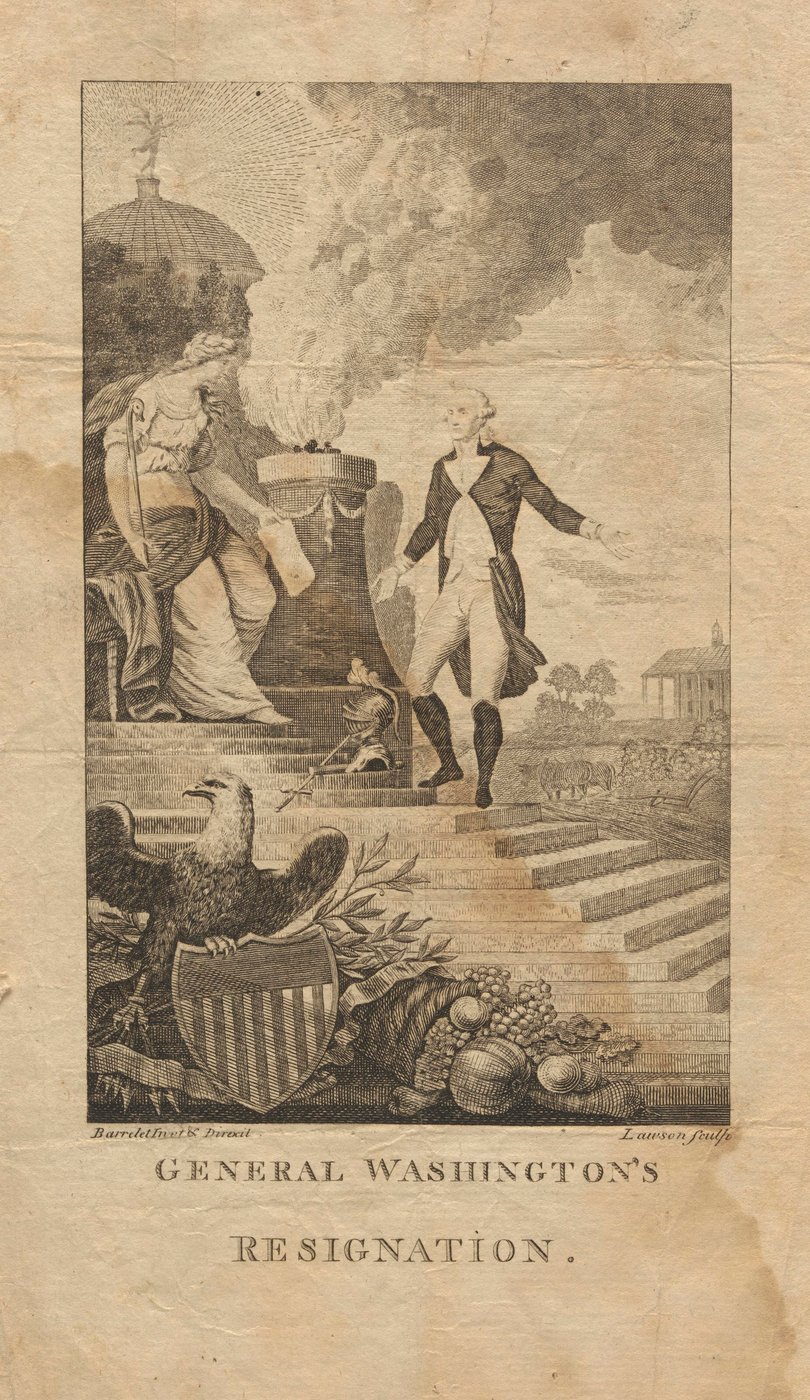
General Washington's Resignation — 1799
National Portrait Gallery, Smithsonian Institution; gift of the McNeil Americana Collection via Smithsonian Open Access (CC0)
Candle stand used by George Washington while writing the Farewell Address, 1796
NMAH via Smithsonian Open Access (CC0)
Quiz yourself