Governance
·
Power Transfers
·
how one-party states maintain internal…
Medium
6 min
Who Actually Keeps a Dictator in Power
Why authoritarian leaders fear their allies more than their enemies
Share
If you ran a country with no elections, no free press, and no opposition party — what would be your biggest threat? A popular uprising? A foreign invasion? Most leaders in that position lose power to the people standing right next to them.
Power doesn't transfer on its own — it requires someone to hand it over, or someone to take it. In democracies, that mechanism is an election. In one-party states, there's no such mechanism written into the rules. So how does a government with no formal succession process stay stable for decades? The answer has less to do with fear and more to do with math.
Political scientists Bruce Bueno de Mesquita (b. 1946, United States) and Alastair Smith (b. 1967, United Kingdom) spent years studying why some leaders last and others fall. Their framework — selectorate theory — starts with a simple observation: no leader rules alone. Every leader, from a democratically elected president to a general who seized the capital last Tuesday, depends on a group of people to stay in power. They called this group the 'winning coalition.'
In a democracy, the winning coalition is enormous — you need millions of voters, so you have to deliver things that benefit millions of people: roads, schools, courts, healthcare. The math forces broad policy.
In a one-party state, the winning coalition is tiny. You need the loyalty of maybe a few dozen generals, a handful of senior party officials, and the heads of key security services. That's it. Keep those people happy, and you stay in power.
Make your call
So if you only need to keep a small group loyal — say, 50 senior officials — what's the smartest way to do it?
A
Pay them very well and give them exclusive privileges unavailable to anyone else
B
Rotate them frequently so no single person builds enough power to threaten you
C
Build genuine public support so the coalition has no reason to defect
The logic is almost brutally simple. If you're one of 50 people who control access to the leader's favor, you're receiving a very large slice of a pie that almost no one else can touch — luxury imports, state contracts, exclusive housing, immunity from prosecution. Your incentive to defect is low, because defection means losing all of that and gambling on a replacement leader who might not include you in their coalition at all.
Now imagine you're one of 50 million voters. Your 'reward' for supporting the government is a paved road and a functioning hospital — things you share with everyone else. Your individual leverage is essentially zero. The leader doesn't need YOUR loyalty specifically; they need enough people like you in aggregate. This is why large-coalition systems tend to produce public goods, and small-coalition systems tend to produce private ones.
Bueno de Mesquita and Smith documented this across dozens of regimes. Leaders with small winning coalitions spend a higher proportion of national revenue on the coalition itself — and a lower proportion on public services — than leaders with large coalitions. The correlation is strong enough to be predictive.
Key Insight
The dictator's real enemy isn't the protesters in the street. It's the general who decides the protesters have a point — and that a new leader might reward him better for switching sides. Every tool of authoritarian control — the secret police, the loyalty purges, the cultivated paranoia — is aimed at that general, not at the crowd.
This is why loyalty purges look paradoxical from the outside. A leader at the height of their power suddenly arrests a dozen senior officials who have served loyally for years. It seems irrational — why remove people who haven't done anything wrong? But selectorate theory makes it legible. A coalition member who has been loyal for a long time has also been accumulating their own influence, their own networks, their own alternative power base. They're becoming replaceable-upward rather than replaceable-downward. The purge isn't punishment — it's maintenance. It resets the coalition's dependence on the leader.
Stalin's purges of the Red Army officer corps in the late 1930s killed tens of thousands of military personnel, including some of the Soviet Union's most competent generals — right before a world war. From a military readiness standpoint, it was catastrophic. From a coalition-management standpoint, it was completely rational. Stalin wasn't optimizing for winning a war. He was optimizing for surviving the peace.
Related threads
Governance
·
The Coup That Forgot to Cut the Phone Lines
·
anatomy of a coup that failed (which…
The Coup That Forgot to Cut the Phone Lines
Governance
·
Why Some Leaders Actually Leave
·
what makes a peaceful transition of…
Why Some Leaders Actually Leave
Governance
·
The Rule That Forces Leaders to Leave
·
what term limits prevent and what they…
The Rule That Forces Leaders to Leave
Sources
Images from Wikimedia Commons. Attribution required by license.
Hitler SS Nuremberg rally 1934 photograph
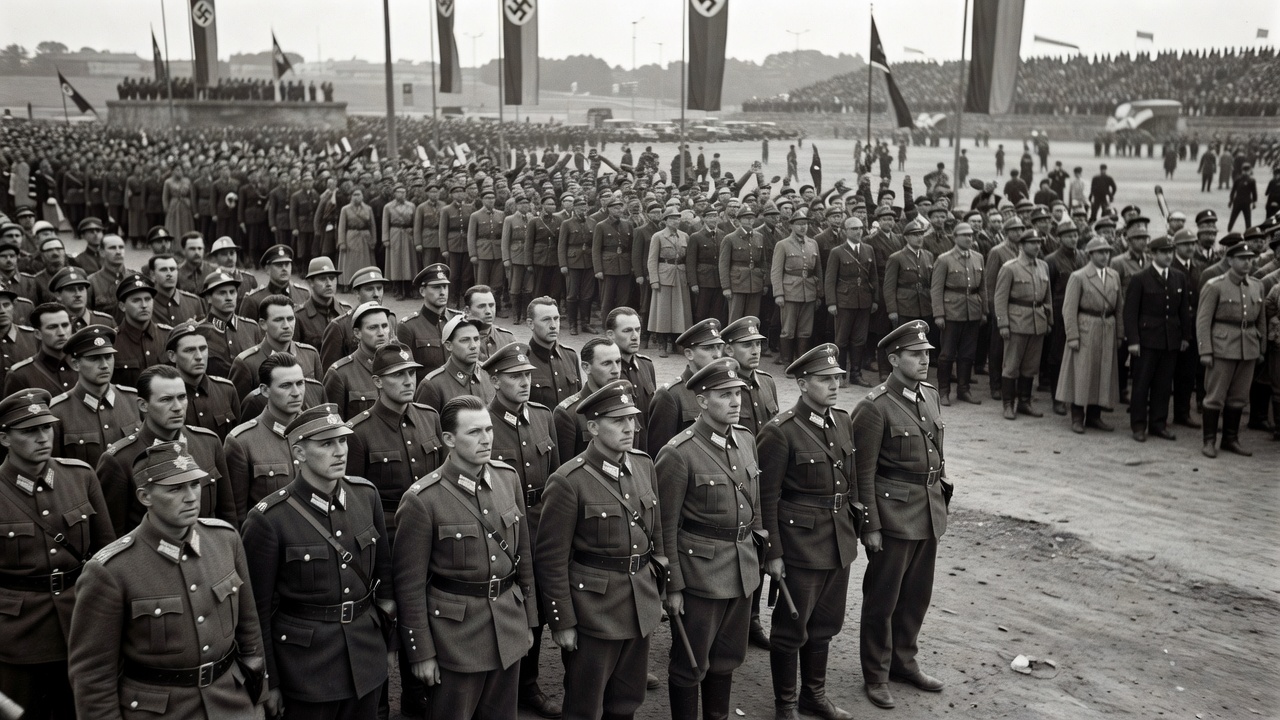
Generated by Grok Imagine (xAI), prompt: Generate a single 16:9 horizontal image for an educational lesson.
Lesson title: "Who Actually Keeps a Dictator in Power" · Why authoritarian leaders fear their allies more than their enemies
Domain: …
As our guides told us in September 2010 (when this picture was taken) that "we are awaiting big news". Later we realized that he was talking about Kim Jong Un.
Exactly one month after this picture was taken, North Korea leader Kim Jong Il and his son Kim Jong Un attended a massive military parade to mark the 65th anniversary of the communist nation's ruling Workers' Party in Pyongyang.
Roman Harak · CC BY-SA 2.0
Quiz yourself