Governance
·
Power Transfers
·
anatomy of a coup that failed (which…
Medium
6 min
Autopsy
The Coup That Forgot to Cut the Phone Lines
Why most coups fail before the shooting starts
Share
August 19, 1991. Soviet hardliners announce that Mikhail Gorbachev is 'ill' and they're taking over the USSR. They have tanks. They have the KGB. They control state television. They lose in three days. What did they forget?
Power — real governmental power — isn't a single thing you grab. It's a web of relationships, infrastructure, and loyalties that have to be maintained every single day. When a government changes hands peacefully, that web gets transferred intact. When it changes violently, someone has to seize enough of the web fast enough that the people still holding the other threads give up. A coup is a race against that web reassembling itself around you. Most coups that fail, fail because the plotters thought they needed to capture a person. What they actually needed to capture was a system.
The 1991 Soviet coup attempt is the cleanest autopsy available. The plotters — eight senior officials calling themselves the State Emergency Committee — had genuine institutional power. Defense Minister Dmitry Yazov controlled the military. KGB chairman Vladimir Kryuchkov controlled intelligence. Interior Minister Boris Pugo controlled the police. On paper, they held every instrument of state violence. They put tanks in Moscow streets. They announced on state television that Gorbachev was incapacitated. By any historical playbook, this should have worked.
Make your call
The plotters had tanks in the streets and state TV on their side. What was the first thing that doomed them?
A
Gorbachev escaped and rallied foreign support against them
B
They left communications infrastructure running, so resistance could organize in real time
C
The military refused all orders from the start
The plotters seized the broadcast tower but left the telephone exchanges untouched. They controlled what went out on state television; they didn't control what moved through private lines, fax machines, or the nascent internet connections at Moscow State University. Boris Yeltsin (b. 1931–2007, Russia) — then President of the Russian Soviet Republic — climbed on a tank outside the Russian parliament building and declared the coup illegal. That image went out over wire services. CNN broadcast it internationally. Foreign governments started making calls. The plotters had seized the megaphone and left the telephone network to their opponents. Within hours, the resistance had better information than the coup leaders did about which military units were actually going to follow orders.
The second failure was loyalty — specifically, the loyalty of the mid-level commanders who would actually have to shoot people. The plotters had the institutional loyalty of generals. They did not have the personal loyalty of the colonels and majors who command actual soldiers. When the order came to storm the Russian parliament building — where thousands of civilians had gathered as a human shield around Yeltsin — the commanders on the ground balked. Three protesters died in a confused confrontation, but the full assault never came. The generals had assumed that institutional rank would translate into obedience under pressure. It didn't. Soldiers who had never been asked to fire on Russian civilians weren't going to start because a Defense Minister they'd never met signed a document. The chain of command is not a chain. It's a series of individual decisions, each one contingent on the last.
Key Insight
A coup doesn't fail when the tanks stop moving. It fails the moment the people holding the guns start asking 'wait — who exactly am I supposed to be loyal to right now?' The plotters' job was to make that question unaskable. They left it wide open.
The lesson isn't specific to the USSR. Every failed coup in the historical record has the same shape: the plotters captured the symbol of power — the palace, the president, the television studio — and left intact the infrastructure through which power actually flows. Myanmar's 2021 military coup succeeded precisely because the generals spent years before the coup cultivating unit-level loyalty and, on the day, cut mobile internet within hours. The Turkish coup attempt in 2016 failed because President Erdoğan reached a phone connection to a television channel and told people to go into the streets — communications infrastructure, again. In both cases, the decisive variable wasn't firepower. It was who controlled the signals.
Related threads
Governance
·
Who Actually Keeps a Dictator in Power
·
how one-party states maintain internal…
Who Actually Keeps a Dictator in Power
Governance
·
Why Some Leaders Actually Leave
·
what makes a peaceful transition of…
Why Some Leaders Actually Leave
Governance
·
The Rule That Forces Leaders to Leave
·
what term limits prevent and what they…
The Rule That Forces Leaders to Leave
Sources
Images from Wikimedia Commons. Attribution required by license.
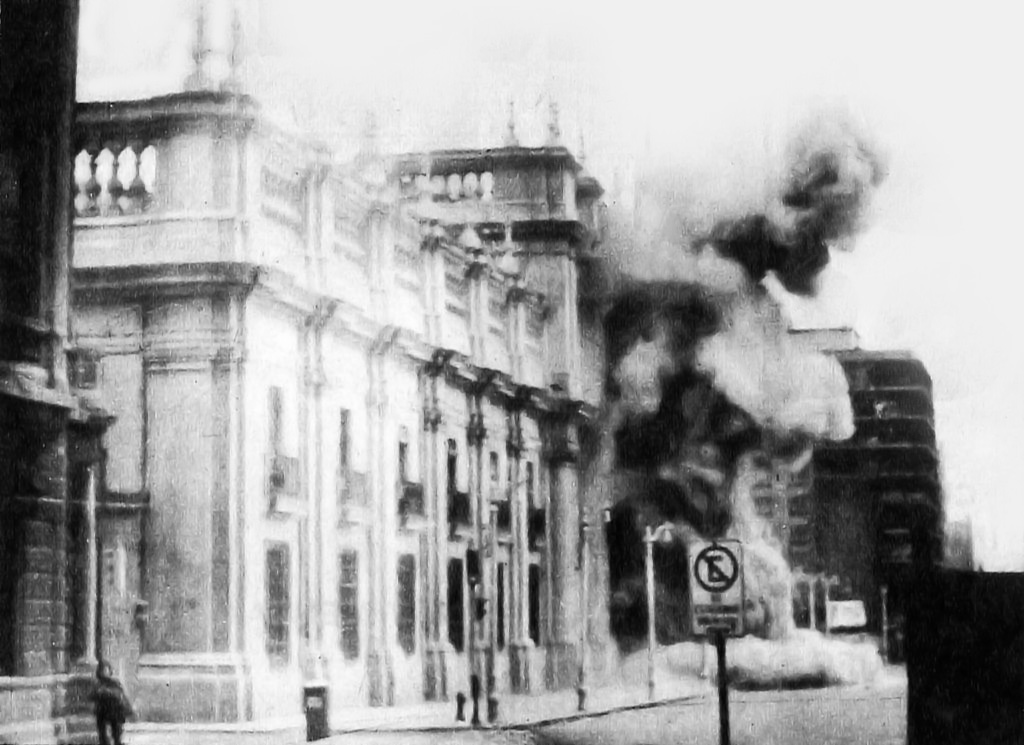
Coup of September 11, 1973. Bombing of La Moneda (presidential palace)
Biblioteca del Congreso Nacional de Chile · CC BY 3.0 cl
General Pinochet - Chile
Library of Congress · Public Domain via Library of Congress
Quiz yourself