Governance
·
System Comparisons
·
what first-past-the-post produces vs…
Medium
6 min
Why Your Vote Might Not Count the Way You Think
Two voting systems that start with the same ballots and end up in completely different countries
Share
Three parties run in an election. Party A gets 40% of the vote. Party B gets 35%. Party C gets 25%. In one country, Party A wins everything. In another, all three share power. Same votes. Completely different governments.
Every democracy holds elections. But the rules for converting votes into seats — that's where things get radically different. Two systems dominate the world: first-past-the-post (used in the US, UK, Canada, India) and proportional representation (used across most of Europe, Latin America, and beyond). The same election, run under different rules, produces different winners, different parties, and different kinds of government. This lesson is about that gap.
First-past-the-post is simple. A country is divided into geographic districts. Each district holds a race. Whoever gets the most votes in that district wins the seat — even if they got 34% and the other two candidates split 66% between them. There's no reward for coming second. You either win your district or you walk away with nothing.
The consequence is brutal and predictable: votes cast for losing candidates count for nothing in terms of representation. If your preferred candidate loses every district by a small margin, your party can win 20% of the national vote and end up with 2% of the seats. This happens. Regularly.
Make your call
Under first-past-the-post, a party wins 37% of the national vote — the highest of any party. What share of parliamentary seats do you think they'd likely end up with?
A
Around 37% — roughly matching their vote share
B
Less than 37% — smaller parties eat into their totals
C
More than 37% — possibly a strong majority
That 2005 UK result isn't a glitch — it's the system working as designed. When votes are spread across hundreds of winner-take-all districts, a party that consistently finishes first (even narrowly) accumulates seats at a faster rate than its vote share would suggest. The result is usually a single-party majority government that can govern without coalition partners. Stable, decisive, but built on a plurality, not a majority.
The flip side: smaller parties get crushed. A party with 10% support spread evenly across the country might finish second or third in every district and win zero seats. To survive under first-past-the-post, parties need geographically concentrated support — which is why regional parties (Scotland's SNP, Quebec's Bloc Québécois) punch above their weight while nationally distributed smaller parties get wiped out.
Proportional representation works on a different premise: your share of seats should match your share of votes. A party that wins 25% of the vote gets roughly 25% of the seats. The mechanics vary — some countries use party lists, others use ranked ballots, others use mixed systems — but the core logic holds.
The immediate effect: more parties survive. When finishing second nationally earns you seats, there's no pressure to consolidate into two mega-parties. Germany typically has five or six parties in parliament. The Netherlands regularly has fifteen or more. Israel has had as many as thirty. Voters with minority views get representation. But — and this is the trade-off — no single party usually wins a majority, so governments are almost always coalitions. Multiple parties negotiate a shared agenda, divide up ministries, and govern together. That process can take weeks or months. In 2021, Germany took nearly two months to form a government after its election. In 2019, Belgium went 652 days without a formal government.
Key Insight
First-past-the-post trades representation for decisiveness: fewer parties, faster governments, clearer mandates — but millions of votes that change nothing. Proportional representation trades decisiveness for representation: more voices at the table, but the table takes longer to build, and sometimes collapses mid-meal. Neither system is broken. They're solving different problems.
Related threads
Governance
·
One State, One Vote — Fair Deal or Broken Math?
·
equal state suffrage
One State, One Vote — Fair Deal or Broken Math?
Governance
·
The Vote That Can End a Government by Lunch
·
how a no-confidence vote removes a…
The Vote That Can End a Government by Lunch
Governance
·
Seven Men in a Room: How China Actually Decides
·
how China's standing committee actually…
Seven Men in a Room: How China Actually Decides
Sources
Images from Wikimedia Commons. Attribution required by license.
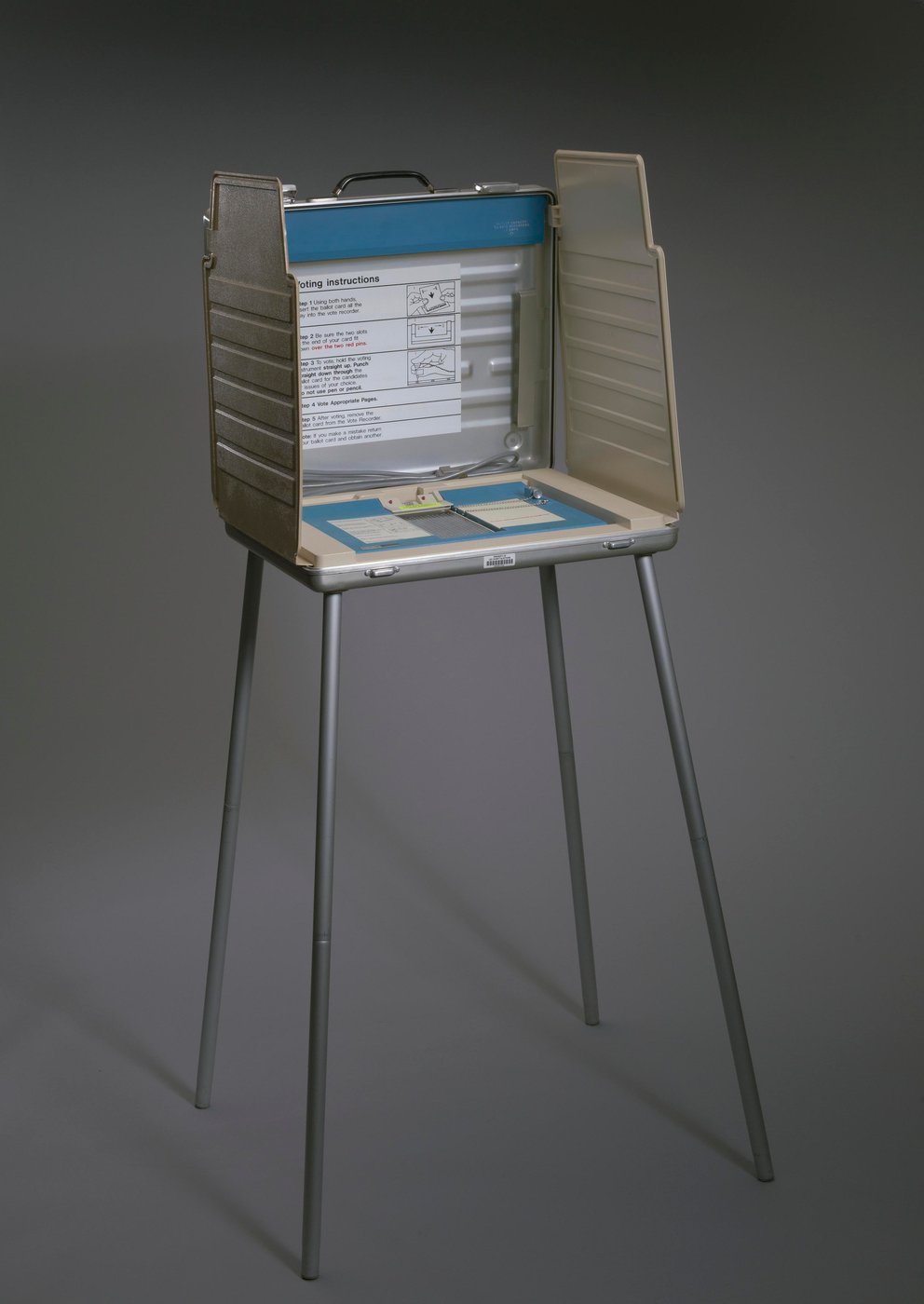
Voting machine used in the 2000 Presidential election — ca. 1990
Collection of the Smithsonian National Museum of African American History and Culture via Smithsonian Open Access (CC0)
The Two Houses of Parliament, from Harrison's History of London — ca. 1750
Given by Mr. and Mrs. Bruno Lasker via Smithsonian Open Access (CC0)
The east side of the Paul-Löbe-Haus in Berlin-Mitte, facing the river Spree, during the blue hour. On the left the Reichstag building can be seen. The Paul Löbe building was built according to plans of architect Stephan Braunfels.
Ansgar Koreng · CC BY-SA 3.0 de
Quiz yourself