Governance
·
System Comparisons
·
how Singapore built a meritocratic…
Medium
6 min
Singapore Pays Its Ministers Like CEOs. Here's Why.
What happens when a government decides to run itself like a corporation
Share
Singapore's Prime Minister earns around $1.6 million USD per year. The US President earns $400,000. Singapore has 6 million people. The US has 330 million. That salary gap isn't an accident — it's a deliberate design choice with consequences that cut both ways.
Every government has to answer one basic question: who actually runs things? Some countries spread power across elected officials, parties, and regional governments. Others concentrate it. Singapore — a city-state smaller than Los Angeles — made a distinctive choice: build a professional civil service so capable and well-compensated that it could outlast any single election, any single leader, any single crisis. The mechanism behind that choice is worth understanding on its own terms, because it shows up in debates about governance everywhere, from Tokyo to Nairobi to Washington.
When Singapore gained independence in 1965, it had almost nothing — no natural resources, a tiny domestic market, and neighbors that weren't especially friendly. Lee Kuan Yew (1923–2015, Singapore) — the country's founding Prime Minister and the architect of its civil service model — concluded that the only real asset Singapore could build was human capital. Specifically: recruit the smartest people in the country into government, pay them enough that private-sector firms can't poach them, and then hold them to measurable performance standards. The model has a name in political science: meritocracy. But Singapore's version is unusually explicit and unusually aggressive about it.
The mechanics work like this. Singapore's government identifies high-performing students early — often at secondary school — and offers them scholarships to study at elite universities anywhere in the world, with a bond requiring them to return and serve in the civil service for several years. Those who perform well get promoted fast, paid well, and given real responsibility early. Senior civil servants and ministers are benchmarked against private-sector salaries in finance and law, then paid a fraction of that benchmark — but a large enough fraction that the gap isn't embarrassing. The result is a bureaucracy that consistently ranks near the top of global corruption indexes. Transparency International has placed Singapore in the top five least-corrupt countries for most of the last two decades.
Make your call
So Singapore built a highly paid, highly selective civil service. What's the main tradeoff a system like this produces?
A
Government becomes too slow — meritocrats debate endlessly instead of deciding
B
A narrow elite controls policy, and dissent gets structurally discouraged
C
High salaries attract talent but drive up taxes to unsustainable levels
Singapore's civil service is genuinely impressive at execution. Infrastructure works. Corruption is rare. Long-term planning — on housing, water, port logistics — operates on 20- and 30-year horizons that most democracies can't sustain past the next election cycle. But the same features that produce those outcomes also produce others. The People's Action Party has governed Singapore continuously since 1959. Opposition politicians have faced defamation suits. Press freedom rankings consistently place Singapore in the bottom third globally. This isn't coincidental. A system designed to reward the right answers, administered by people selected for agreeing on what the right answers are, tends to develop a low tolerance for people who question the framework itself. The meritocracy is real. So is the narrowing.
Key Insight
The deepest tension in Singapore's model: meritocracy selects for competence at executing existing goals. It doesn't select for questioning whether the goals are right. A civil service that's very good at the second thing and weak at the first is a bureaucracy. A civil service that's very good at the first thing and weak at the second is something else — efficient, stable, and structurally resistant to the kind of friction that democratic systems use to catch their own mistakes.
Related threads
Governance
·
One State, One Vote — Fair Deal or Broken Math?
·
equal state suffrage
One State, One Vote — Fair Deal or Broken Math?
Governance
·
The Vote That Can End a Government by Lunch
·
how a no-confidence vote removes a…
The Vote That Can End a Government by Lunch
Governance
·
Seven Men in a Room: How China Actually Decides
·
how China's standing committee actually…
Seven Men in a Room: How China Actually Decides
Sources
Images from Wikimedia Commons. Attribution required by license.
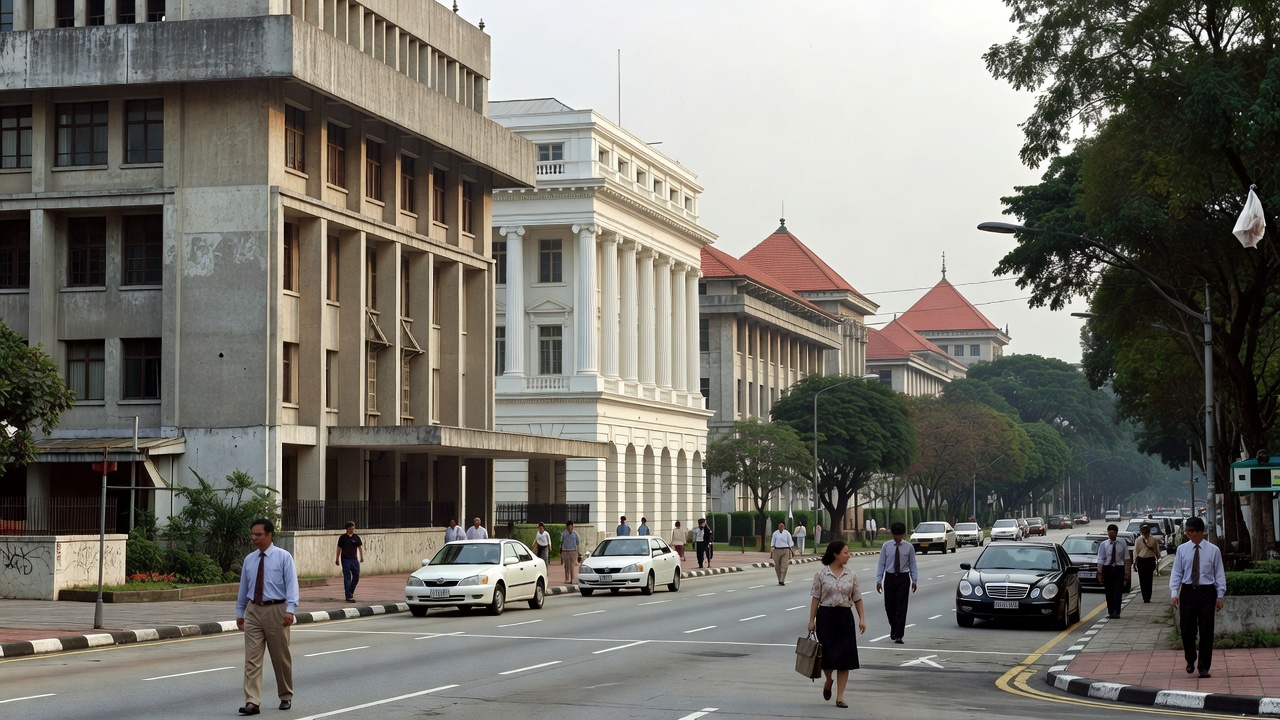
Singapore government buildings
Generated by Grok Imagine (xAI), prompt: Generate a single 16:9 horizontal image for an educational lesson.
Lesson title: "Singapore Pays Its Ministers Like CEOs. Here's Why." · What happens when a government decides to run itself like a cor…
[Lee Kuan Yew, first prime minister of Singapore]
Library of Congress · Public Domain via Library of Congress
Quiz yourself