Governance
·
System Comparisons
·
how China's standing committee actually…
Medium
6 min
Seven Men in a Room: How China Actually Decides
Why the world's most powerful committee almost never votes
Share
The United States has 535 members of Congress. The European Parliament has 720. China — a country of 1.4 billion people — concentrates its highest decision-making in a committee of seven. How does that actually work?
Different governments park power in different places. In some systems, a parliament checks an executive. In others, states negotiate with a center. This lesson series maps where power actually sits across the world's major arrangements — without ranking them. This lesson focuses on one of the most consequential and least understood structures: the Politburo Standing Committee of the Chinese Communist Party, the body that effectively governs 1.4 billion people.
China has a state government — a president, a cabinet, a legislature called the National People's Congress. Those institutions are real and they do real administrative work. But the Party sits above the state. The Chinese Communist Party has roughly 98 million members, organized into a pyramid. At the base: local party branches. Above that: a National Congress of about 2,300 delegates, which meets every five years. That Congress elects a Central Committee of roughly 200 members. The Central Committee elects a Politburo of 24. And the Politburo elects the Standing Committee — currently seven people — which is where the actual decisions happen. The state apparatus executes. The Standing Committee decides.
Make your call
When the seven members of the Standing Committee need to make a major decision — say, a significant policy shift or a response to a national crisis — how do you think they reach a conclusion?
A
They hold a formal vote, with the majority position binding
B
The General Secretary decides unilaterally and the others ratify
C
They deliberate until they reach a consensus, with dissent handled before the meeting
The Standing Committee operates on a principle called democratic centralism — a term with a specific technical meaning inside the Party. Before any formal meeting, members consult bilaterally. Staff prepare documents. Positions are circulated. By the time seven people are in the same room, the goal is not to debate but to ratify a position that has already been negotiated into shape. Formal votes are rare. Unanimous outcomes are the norm — not because everyone always agrees, but because the system is designed to resolve disagreement before it becomes visible. A split vote at the top level would signal weakness; the structure actively prevents that signal from appearing.
This is not a rubber stamp in the dismissive sense. The pre-meeting negotiation is where the real deliberation happens. It's just invisible to outsiders — and largely invisible to the historical record.
The General Secretary — currently Xi Jinping (b. 1953, Beijing), who also holds the titles of President and Chair of the Central Military Commission — chairs the Standing Committee and sets its agenda. The agenda-setting function matters enormously: what the committee discusses, and in what frame, shapes what it can decide. Under different General Secretaries, the balance of power within the committee has varied. During the 1990s and 2000s, the committee operated with more collective weight distributed across its members, with different members holding clear portfolio authority over their domains. Since roughly 2012, authority has consolidated more visibly toward the General Secretary's position — though the committee structure itself remains intact.
Portfolio assignments still exist. Each member of the Standing Committee oversees a cluster of policy areas — the economy, security, ideology, anti-corruption. They bring expertise and institutional relationships from those domains into the consensus process.
Key Insight
The Standing Committee doesn't govern by commanding every decision. It governs by setting the boundaries of what is possible — which policies are in play, which are off the table, who rises and who doesn't. Most of China's day-to-day administration happens far below this level. The committee's power is structural: it controls the frame, not every picture inside it.
Membership in the Standing Committee is itself a product of a negotiated process. There are informal norms — members typically retire at 68, serve one or two five-year terms, and are drawn from senior provincial or ministerial experience. The selection process happens through consultations among current and retired senior leaders, not through a public election or even a transparent internal vote. This means the committee's composition reflects accumulated political relationships and factional balances as much as any formal criterion.
The result is a system that is simultaneously highly centralized — seven people at the apex — and deeply dependent on informal networks to function. The formal structure and the informal process are both real. Understanding one without the other misses how decisions actually get made.
Related threads
Governance
·
One State, One Vote — Fair Deal or Broken Math?
·
equal state suffrage
One State, One Vote — Fair Deal or Broken Math?
Governance
·
The Vote That Can End a Government by Lunch
·
how a no-confidence vote removes a…
The Vote That Can End a Government by Lunch
Governance
·
Singapore Pays Its Ministers Like CEOs. Here's Why.
·
how Singapore built a meritocratic…
Singapore Pays Its Ministers Like CEOs. Here's Why.
Sources
Images from Wikimedia Commons. Attribution required by license.
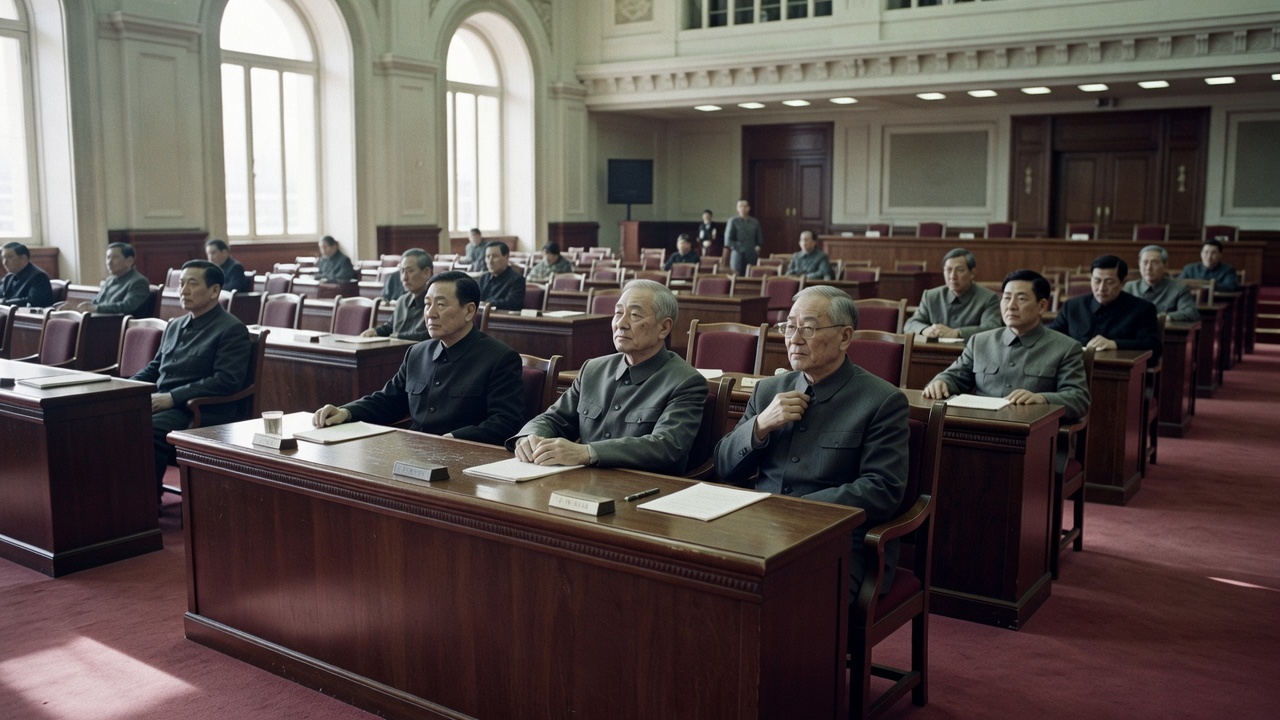
China Great Hall People
Generated by Grok Imagine (xAI), prompt: Generate a single 16:9 horizontal image for an educational lesson.
Lesson title: "Seven Men in a Room: How China Actually Decides" · Why the world's most powerful committee almost never votes
Domain: …
Politburo Standing Committee China
Generated by Grok Imagine (xAI), prompt: Generate a single 4:3 horizontal image for an educational lesson.
Lesson title: "Seven Men in a Room: How China Actually Decides" · Why the world's most powerful committee almost never votes
Domain: g…
Quiz yourself