Governance
·
System Comparisons
·
how a no-confidence vote removes a…
Medium
5 min
The Vote That Can End a Government by Lunch
Why a prime minister can be fired by their own parliament in a single afternoon
Share
It's a Tuesday. A prime minister wakes up as the head of government. By 3pm, parliament votes. By 5pm, they're clearing out their desk. No election. No scandal trial. Just a vote.
In most democracies, the person running the government isn't directly elected by the public — they're elected by the legislature. This is the core of a parliamentary system, used by the UK, Canada, Germany, India, Japan, and dozens of others. The prime minister holds power because a majority of parliament supports them. And that's exactly the vulnerability: the same body that put them in can take them out.
A no-confidence vote is parliament formally declaring: we no longer trust this government to lead. It's not a criminal charge. It's not an impeachment. It's closer to a job review where the reviewers have the power to fire you on the spot. The prime minister doesn't answer to voters directly — they answer to parliament. Lose parliament's support, lose the job.
Make your call
So what actually happens when a no-confidence vote passes? The prime minister loses the vote — what comes next?
A
The prime minister stays in office until the next scheduled election
B
The prime minister must resign or call a new election
C
The parliament automatically dissolves and everyone loses their seats
When a no-confidence vote passes, the prime minister faces a binary choice. Resign — allowing parliament to form a new government, usually by finding a different MP who can command a majority. Or call a general election — going back to the voters and asking them to settle the question. Either way, the current government is finished. The vote is the mechanism; resignation or dissolution is the result.
The UK saw this play out in slow motion between 2017 and 2019. Theresa May's government survived a formal no-confidence vote in January 2019 by just 19 votes — but the writing was on the wall. She resigned months later anyway, not because she lost a formal vote, but because she'd lost the informal one: her own party stopped backing her.
Key Insight
The no-confidence mechanism is what makes a parliamentary prime minister fundamentally different from a president. A president like the one in the United States serves a fixed term — Congress can't simply vote them out because they dislike the policy direction. A prime minister serves only as long as parliament says so. Power is borrowed, not owned.
Example
Germany built a specific safeguard against the chaos this can cause. After the Weimar Republic collapsed partly because governments fell in rapid succession, Germany's Basic Law introduced the 'constructive vote of no confidence.' Parliament can only remove a chancellor if it simultaneously agrees on a replacement. You can't just fire the government — you have to have a new one ready to go. It's been used successfully only once, in 1982, when Helmut Kohl replaced Helmut Schmidt. The mechanism slows the removal down on purpose, trading speed for stability.
Britain has no such requirement. Canada doesn't either. In those systems, a government can fall and an election must follow — with all the uncertainty that brings.
Related threads
Governance
·
One State, One Vote — Fair Deal or Broken Math?
·
equal state suffrage
One State, One Vote — Fair Deal or Broken Math?
Governance
·
Seven Men in a Room: How China Actually Decides
·
how China's standing committee actually…
Seven Men in a Room: How China Actually Decides
Governance
·
Singapore Pays Its Ministers Like CEOs. Here's Why.
·
how Singapore built a meritocratic…
Singapore Pays Its Ministers Like CEOs. Here's Why.
Sources
Images from Wikimedia Commons. Attribution required by license.
parliament no confidence vote
Generated by Grok Imagine (xAI), prompt: Generate a single 16:9 horizontal image for an educational lesson.
Lesson title: "The Vote That Can End a Government by Lunch" · Why a prime minister can be fired by their own parliament in a single a…
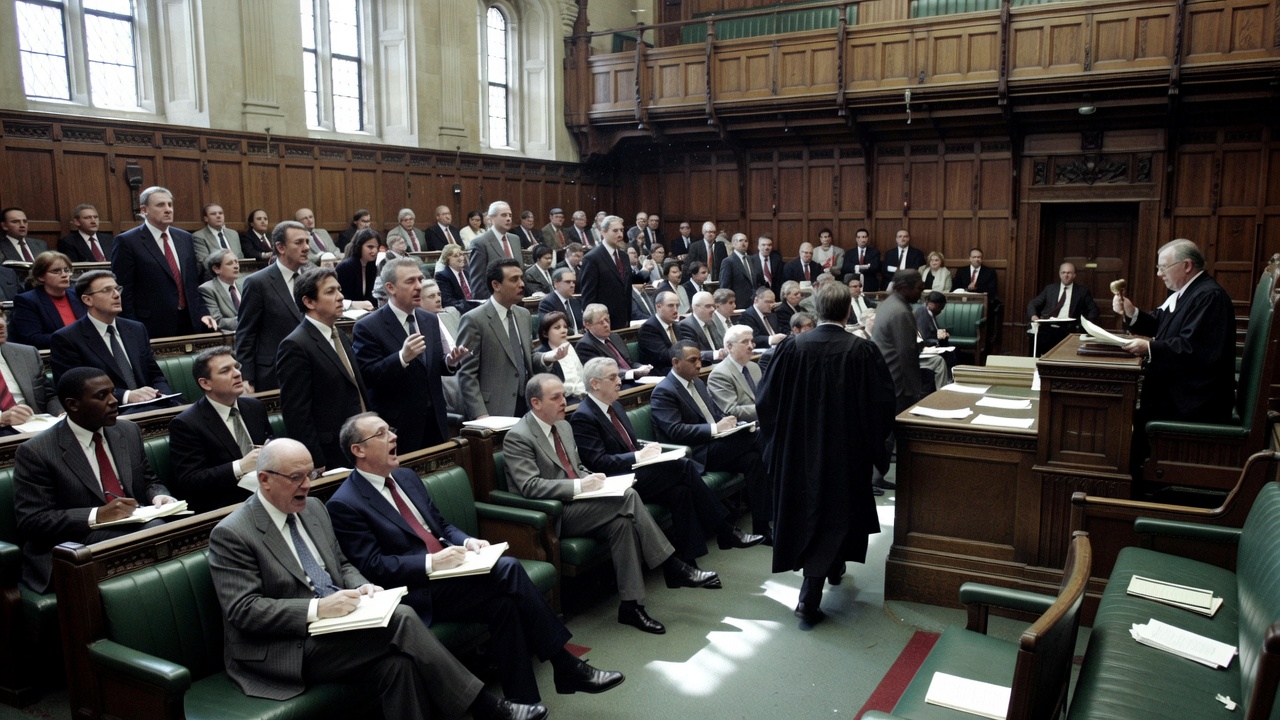
UK House of Commons chamber
Generated by Grok Imagine (xAI), prompt: Generate a single 4:3 horizontal image for an educational lesson.
Lesson title: "The Vote That Can End a Government by Lunch" · Why a prime minister can be fired by their own parliament in a single af…
Quiz yourself