Governance
·
System Comparisons
·
equal state suffrage
Medium
6 min
Debate
One State, One Vote — Fair Deal or Broken Math?
Why Wyoming and California share the same number of senators
Share
Wyoming has about 580,000 people. California has 39 million. In the United States Senate, they each get two votes. That means one Wyoming senator represents roughly 290,000 people. One California senator represents 19 million. Same job. Same vote. Wildly different math.
The US Senate is one of the world's most studied examples of a structural choice that every democracy has to make: when you're building a government out of smaller units — states, provinces, cantons — do you give each unit equal weight, or do you weight representation by population? Most countries answer that question differently for different chambers. The US answered it by giving states equal suffrage in the Senate and population-based seats in the House. That arrangement is 235 years old. Whether it still makes sense is one of the most heated structural debates in American politics — and informed people land on genuinely opposite sides.
The debate starts at the founding. In 1787, the Constitutional Convention was close to collapse. Large states (Virginia, Pennsylvania, Massachusetts) wanted representation proportional to population. Small states (New Jersey, Delaware) refused — they'd be permanently outvoted and knew it. Roger Sherman of Connecticut proposed the deal that saved the convention: a two-chamber legislature where the lower house used population and the upper house gave every state exactly two seats regardless of size. Without that deal, there likely is no Constitution. Small states simply wouldn't have signed. The equal-suffrage rule wasn't an accident or an oversight — it was the price of union.
Position A: equal state suffrage is structurally sound and worth preserving. The Senate was never meant to represent individual Americans — the House does that. The Senate represents states as political units, and states, regardless of population, have equal legal standing in the federal system. A small state still has a coastline to protect, a tax base to negotiate, federal land to manage. Erasing its equal voice doesn't make the system more democratic; it makes the federal bargain one-sided. Defenders also point out that the Senate's malapportionment acts as a brake on majoritarian overreach — it forces broad geographic coalitions rather than letting a handful of densely populated metros drive national policy. James Madison (1751–1836, Virginia) — primary architect of the Constitution — argued in Federalist No. 62 that the Senate's structure was a necessary concession to the federal character of the union, not a flaw in it.
Make your call
Before the counterargument: what do you think is the strongest critique of equal state suffrage today?
A
Small states vote as a bloc and always outvote large states
B
A Wyoming vote in Senate elections is worth roughly 68 California votes — distorting who sets national policy
C
The Senate should be abolished entirely
Position B: the founding bargain has become a representation crisis. In 1790, the largest state (Virginia) was about 12 times the size of the smallest (Delaware). Today, California is roughly 68 times the size of Wyoming. The gap the Senate was designed to manage has become something structurally different — a system where the 22 smallest states, representing about 11% of the US population, can collectively block legislation supported by the other 89%. Critics note that the Senate's geographic tilt has also grown more politically uniform over time: rural, small states now lean heavily toward one party, which means equal state suffrage doesn't just produce geographic imbalance, it produces persistent partisan imbalance. The people most affected by federal policy on healthcare, housing, and climate are concentrated in large states. Their senators have a fraction of the structural leverage. Political scientists like Frances Lee (b. 1969, United States) — who studies Senate representation — have documented how the chamber's composition shapes which issues get floor time and which don't.
What would actually settle this? Neither side has the evidence they'd need to close the argument. Defenders of equal suffrage can't prove that a population-weighted Senate would produce worse policy outcomes — we don't have a control group. Critics can't prove that the current system's distortions are the primary driver of legislative gridlock, rather than party polarization, the filibuster, or other mechanisms. The one data point that might move the debate is a natural experiment: countries with population-weighted upper chambers (Germany's Bundesrat, for instance, weights state votes by population tier) could be compared on policy responsiveness — but those systems differ in so many other ways that clean comparison is nearly impossible. The equal-suffrage rule is also the one part of the Constitution that cannot be amended without unanimous state consent, per Article V. Which means the debate is, for now, entirely academic — the structure isn't changing. What it does change is how you read every Senate vote you'll ever watch.
Related threads
Governance
·
The Vote That Can End a Government by Lunch
·
how a no-confidence vote removes a…
The Vote That Can End a Government by Lunch
Governance
·
Seven Men in a Room: How China Actually Decides
·
how China's standing committee actually…
Seven Men in a Room: How China Actually Decides
Governance
·
Singapore Pays Its Ministers Like CEOs. Here's Why.
·
how Singapore built a meritocratic…
Singapore Pays Its Ministers Like CEOs. Here's Why.
Sources
Images from Wikimedia Commons. Attribution required by license.
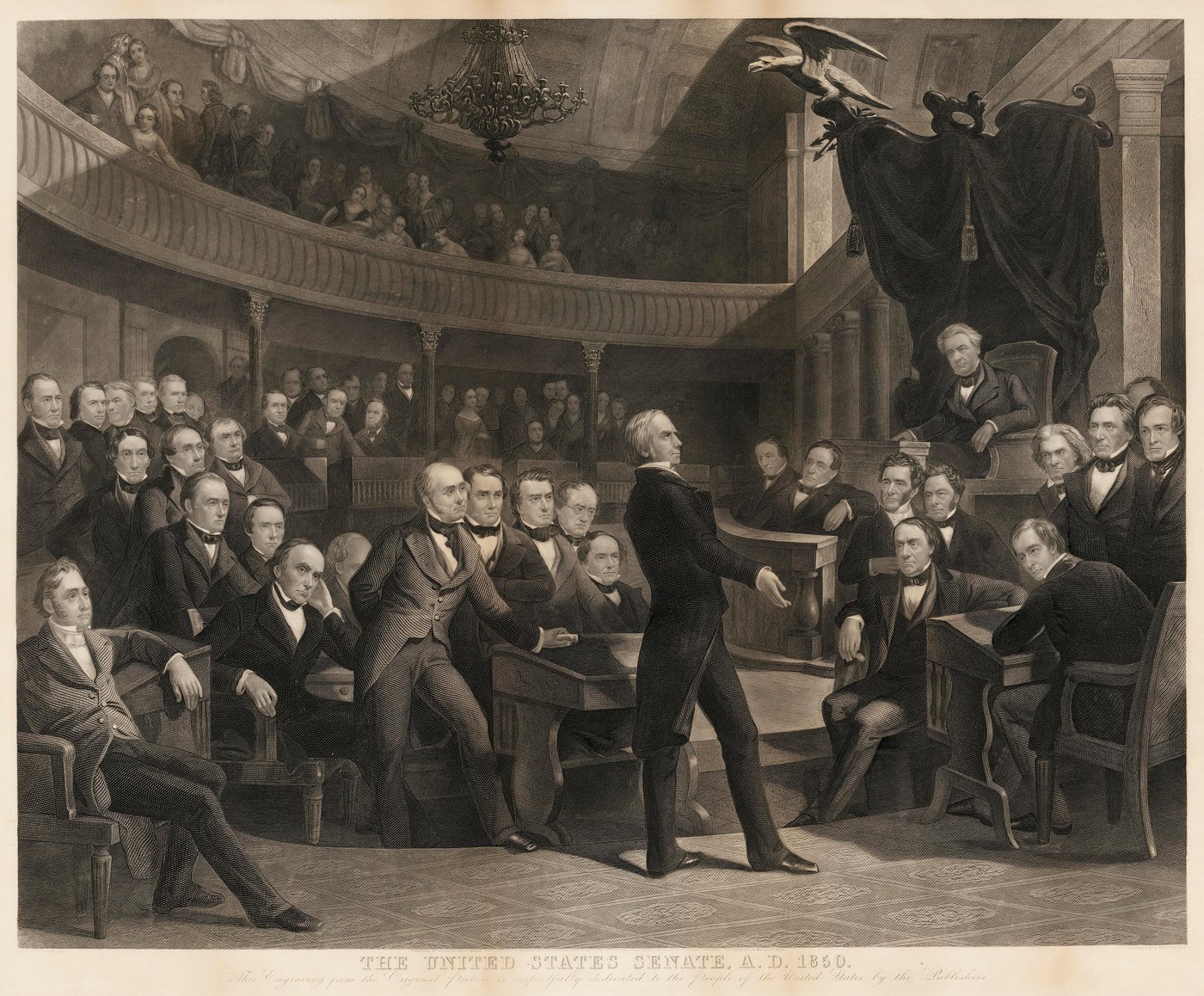
United States Senate Chamber — 1855
National Portrait Gallery, Smithsonian Institution; gift of Mrs. Richard K. Doud via Smithsonian Open Access (CC0)
James Madison — c. 1829-30
National Portrait Gallery, Smithsonian Institution via Smithsonian Open Access (CC0)
Quiz yourself