Governance
·
Mechanism Foundations
·
Duverger's law
Medium
5 min
Why Democracies Keep Collapsing to Two Parties
The voting rule that quietly kills third parties before they start
Share
The US, UK, and Canada all have dozens of political parties. Most elections are decided by two. That's not a coincidence — it's a mathematical trap baked into the ballot itself.
Before you can understand any specific government — why the US gridlocks, why the UK can swing hard in one direction overnight, why some countries have eight parties in parliament and others have two — you need to understand the forces that shape political systems before anyone casts a single vote. One of the most powerful: the rules of the ballot itself. Change how you vote, and you change which parties survive. Maurice Duverger (1917–2014, France) — a political scientist who spent decades studying electoral systems — noticed something striking in the 1950s. Countries that used a specific voting method kept producing two dominant parties, almost regardless of how many parties started out. He called it a law. It's held up remarkably well.
The voting method in question is called first-past-the-post, or FPTP. The rule is simple: you pick one candidate. The candidate with the most votes wins. No runoffs, no rankings, no proportional anything. Just: most votes takes the seat. That simplicity is exactly what makes it a trap.
Make your call
Imagine a country with three parties: Red, Blue, and Green. Green voters actually prefer Red over Blue. It's election day. What do most Green voters do?
A
Vote Green — their actual first choice
B
Vote Red — to keep Blue from winning
C
Stay home — their vote won't matter anyway
This is the mechanism Duverger identified: voters in a first-past-the-post system are constantly doing math in their heads. If your preferred party is polling at 8%, voting for them doesn't just fail to help — it actively hurts the larger party you'd prefer over the one you hate most. Political scientists call this 'strategic voting' or 'tactical voting.' Voters abandon their real preference to avoid wasting their vote on a guaranteed loser. Over time, donations dry up. Media coverage shrinks. Candidates stop running under the third-party banner. The party collapses — not because nobody liked its ideas, but because the ballot structure made supporting it feel irrational. Ralph Nader's 2000 US presidential run is the textbook case: 97,000 Nader votes in Florida, George W. Bush winning the state by 537. Whether you think Nader cost Al Gore the election is contested — but the fear that he might have is exactly what Duverger predicts. By 2004, Green Party support had cratered.
Key Insight
Duverger's law doesn't say two parties are natural or inevitable. It says: first-past-the-post voting creates a structural incentive for voters to abandon third parties, which starves those parties of votes, money, and candidates — until two parties dominate. The cause isn't culture or history. It's the ballot.
The inverse test makes this sharper. Countries using proportional representation — where parties win seats in proportion to their vote share — routinely sustain five, six, eight parties in parliament. Germany, the Netherlands, Sweden. If you get 12% of the vote, you get roughly 12% of the seats. Voting for a small party isn't wasted. So people do it. The parties survive. Duverger noticed this too and folded it into his law: proportional systems tend toward multiple parties, FPTP systems tend toward two. Canada is the sharpest anomaly — it uses FPTP and has had a persistent third party (the NDP) for decades. Duverger called it a law, not a guarantee. Regional concentration of support can keep a third party alive even under FPTP, because in specific districts, they're not the third option — they're competitive. But nationally? The two-party gravity keeps pulling.
Related threads
Governance
·
Why Every Organization Eventually Fights Itself
·
principal-agent problems
Why Every Organization Eventually Fights Itself
Governance
·
Politicians Are Just Sellers With Different Products
·
public-choice theory
Politicians Are Just Sellers With Different Products
Governance
·
The Regulator Who Came From the Industry
·
regulatory capture
The Regulator Who Came From the Industry
Sources
Images from Wikimedia Commons. Attribution required by license.
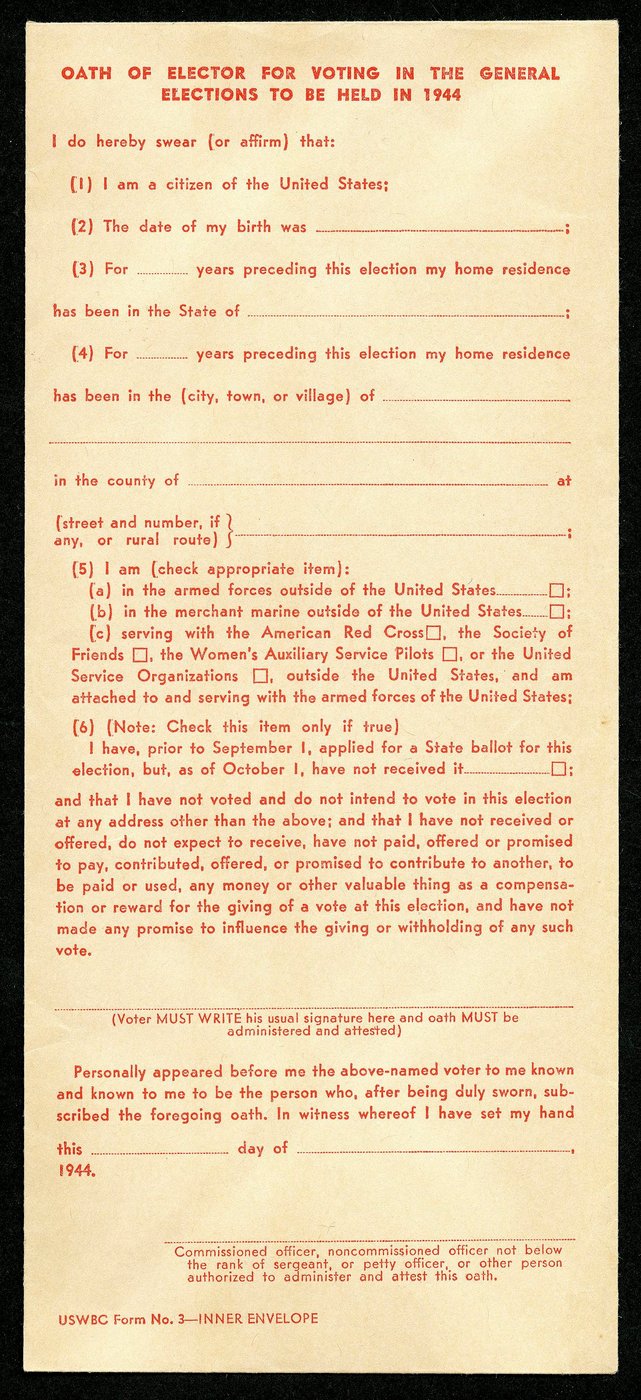
Absentee ballot interior return envelope — 1944
Gift of the Estate of Jean Frances Callahan via Smithsonian Open Access (CC0)
William Howard Taft — c. 1910
National Portrait Gallery, Smithsonian Institution; gift of William E. Schevill via Smithsonian Open Access (CC0)
Quiz yourself