Geography
·
Islands Make Everything Weirder
Medium
7 min
Islands Make Everything Weirder
Cut a place off from the world and watch what happens to everything living there
Share
There's a bird in New Zealand called the kiwi. It can't fly, it has nostrils at the tip of its beak, and it lays an egg so enormous relative to its body that it's basically giving birth to a watermelon. This is what happens when evolution runs unsupervised on an island for 70 million years.
Islands are natural experiments. When a piece of land gets surrounded by ocean — whether it broke off from a continent, got pushed up by a volcano, or rose from a coral reef — everything on it gets cut off. No new predators wandering in. No competing species showing up. No genetic mixing with the mainland. Just whatever made it there, left alone to figure things out.
And isolation, it turns out, is the most powerful force in biology, culture, and economics. It takes ordinary things and makes them extraordinary — or extraordinarily fragile — depending on what happens next.
Analogy
Think about what happens in a group chat when one person goes off-grid for six months — no social media, no news, no outside influence. They come back with completely different opinions, references, and vibes. They've evolved independently. Now imagine that happening to an entire species over millions of years, with no way back into the chat. That's island evolution. The longer the isolation, the weirder and more specialized the result.
Make your call
The kiwi is bizarre — but *why* does island isolation produce such extreme weirdness? What's the core force at work when you cut a species (or a culture) off from the rest of the world?
A
Isolation speeds up random mutation, so stranger traits appear faster
B
Isolation removes the outside pressures that would normally keep traits in check, so evolution runs in whatever direction local conditions push — uncorrected
C
Islands have harsher environments that force species to adapt more dramatically
Islands produce two opposite effects simultaneously.
On one hand, species diversify explosively. One ancestral finch lands on the Galápagos. No competition, lots of empty ecological niches. Within a few million years, you've got 15 different finch species — some with thick beaks for cracking seeds, some with thin beaks for probing flowers. Darwin saw this — and it cracked open his entire theory of evolution. The kiwi is just what happens when that same unchaperoned process runs for 70 million years with no one to tell it to stop.
On the other hand, island species often lose defenses they no longer need. No predators? Why waste energy on flight? Why bother running fast? Why be afraid of anything? Island animals become famously tame — which sounds charming until humans show up with rats and dogs and suddenly 'tame' means 'extinct in a decade.'
Key Insight
Islands are biodiversity hotspots and extinction hotspots at the same time. The same isolation that creates unique species makes them catastrophically vulnerable the moment that isolation breaks.
The same logic applies to human cultures on islands. Isolation doesn't just shape animals — it shapes languages, traditions, and social structures.
Iceland has preserved a version of Old Norse so intact that modern Icelanders can read 800-year-old sagas without a translator. Why? Because very few people moved in or out for centuries. The language had nowhere to drift to. Meanwhile, Papua New Guinea — a large island with rugged terrain that created internal isolation — has over 800 distinct languages spoken within its borders. Isolation within isolation.
Island cultures develop intense local identity, unique art forms, and governance systems that look nothing like their continental neighbors. They also develop deep knowledge of their specific environment — Pacific Islander navigation using stars, currents, and wave patterns was so precise it crosses entire oceans without instruments.
Example
Japan is the clearest case study on the planet. For over 200 years — from 1603 to 1853 — Japan's rulers deliberately enforced isolation. No foreign trade, no foreign travel, no outside influence. The result was one of the most internally coherent cultures ever built: unique art, architecture, cuisine, philosophy, and social hierarchy that developed in a sealed system.
Then Commodore Perry showed up with American warships in 1853 and forced Japan to open its ports. Within 50 years, Japan industrialized faster than almost any nation in history — because it had 200 years of compressed, focused cultural energy ready to be redirected. Isolation built the spring. Contact released it.
But isolation also means vulnerability.
Island nations are among the most exposed to measured sea level rise. They didn't contribute meaningfully to global industrial emissions. But rising seas don't negotiate. Kiribati, Tuvalu, and the Maldives are all facing the real possibility of becoming uninhabitable within decades — because of their geography. An island 2 meters above sea level has no high ground to retreat to.
And it's not just sea level. Islands depend on specific, fragile ecosystems. Coral reefs bleach as ocean temperatures rise. Freshwater lenses — the thin layer of drinkable water that sits above saltwater underground — get contaminated as seas rise. One invasive species, one oil spill, one hurricane can undo what took millions of years to build.
Key Insight
The same features that make islands fascinating — their uniqueness, their isolation, their tight ecological balance — are exactly what make them so easy to destroy. You can't just move an island's ecosystem somewhere else. When it's gone, it's gone.
Sources
Images from Wikimedia Commons. Attribution required by license.
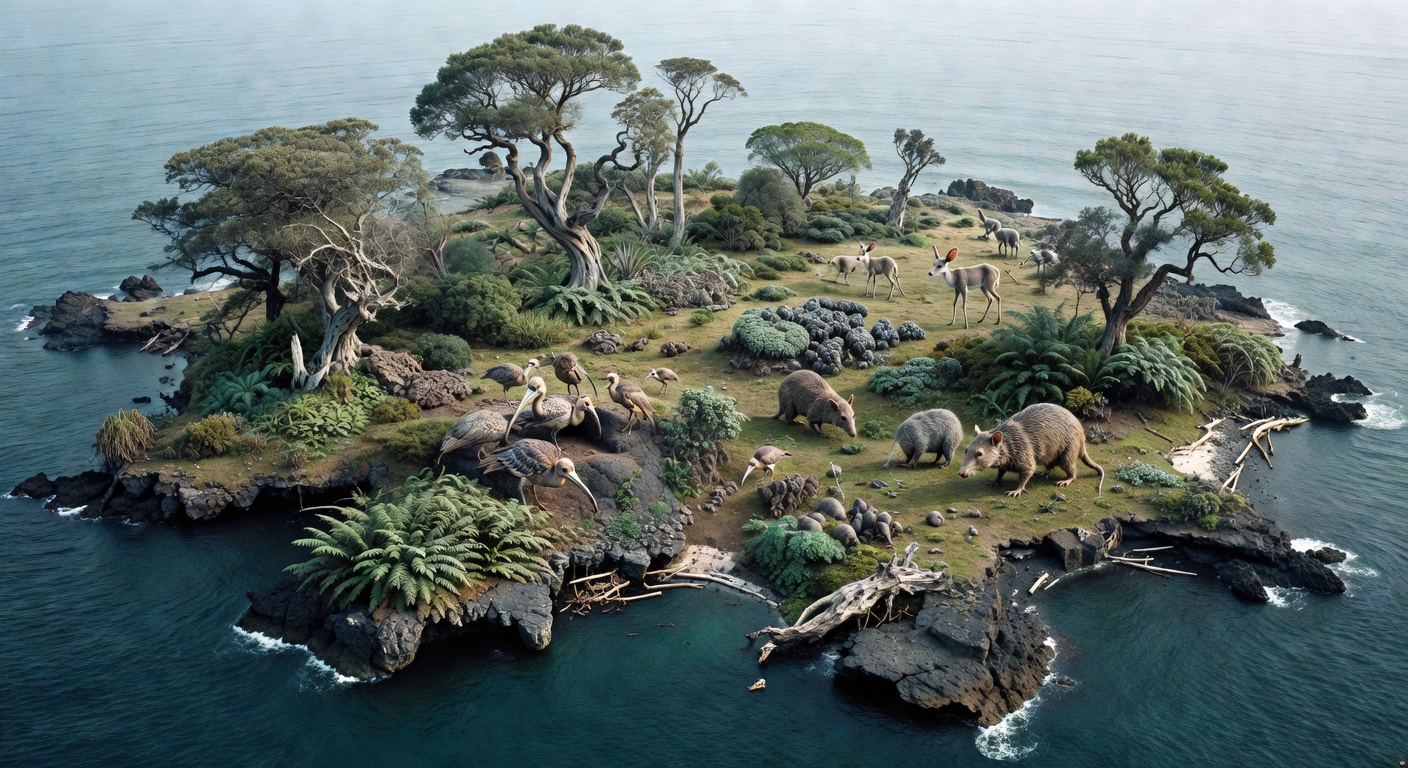
remote island aerial view
Generated by Grok Imagine (xAI), prompt: Generate a single 16:9 horizontal image for an educational lesson.
Lesson title: "Islands Make Everything Weirder" · Cut a place off from the world and watch what happens to everything living there
Do…
NASA -- Image courtesy Jacques Descloitres, rapidfire.sci.gsfc.nasa.gov/ MODIS Land Rapid Response Team at NASA GSFC — Galapagos Islands: Image of the Day — 2002-03-12
NASA -- Image courtesy Jacques Descloitres, rapidfire.sci.gsfc.nasa.gov/ MODIS Land Rapid Response Team at NASA GSFC via Internet Archive (Internet Archive)
Plaster cast of the dried Oxford head and London foot of a Dodo bird at the Booth Museum of Natural History, Brighton, England. The Oxford University Museum of Natural History owns the only remaining Dodo tissue samples, and the foot is now lost.
Ed Schipul from Houston, TX, US · CC BY-SA 2.0
Quiz yourself