Geography
·
The Tiny Strips of Water That Run the World
Medium
7 min
The Tiny Strips of Water That Run the World
A few narrow passages control trillions in trade and the power of nations
Share
In 2021, one ship got stuck sideways in the Suez Canal for six days. It cost the global economy an estimated $9.6 billion per day. One ship. Six days. That's how fragile the system holding the world together actually is.
Picture a map of the world. Now imagine you're a shipping company trying to move oil from Saudi Arabia to Europe, or electronics from China to New York. You can't just draw a straight line across land — most of that is in the way. So your cargo has to travel by sea, through specific, unavoidable passages. A lot of those passages are shockingly narrow. Some are just a few miles wide. These are chokepoints, the pinch points of global trade, and almost everything you own passed through at least one of them.
The big three chokepoints are the Suez Canal, the Panama Canal, and the Strait of Hormuz, and they couldn't be more different from each other. The Suez Canal is man-made, slicing through Egypt to connect the Mediterranean Sea to the Red Sea. Without it, ships sailing from Asia to Europe would have to go all the way around the southern tip of Africa, adding roughly 7,000 miles and two extra weeks to the journey. The Panama Canal does the same trick for the Americas, cutting through the narrow waist of Panama to connect the Atlantic and Pacific. Before it existed, ships had to round Cape Horn at the tip of South America, one of the most dangerous stretches of ocean on Earth. The Strait of Hormuz is different: it's entirely natural, just 21 miles wide at its narrowest point, sitting between Iran and Oman. About 20% of the world's entire oil supply passes through it. Every day.
Make your call
One ship blocked the Suez Canal for six days and cost the world nearly $10 billion a day. So what actually makes a narrow strip of water that powerful? Why can't the world just route around it?
A
The detours are so dangerous that ships simply can't take them
B
There's no good alternative — bypassing a major chokepoint adds thousands of miles, weeks of time, and enormous cost
C
Most countries have agreements that make closing these passages illegal, so the threat is mostly political
Key Insight
That's exactly why one stuck ship could bleed $9.6 billion a day — and here's the core insight: chokepoints turn geography into leverage. Any country that sits next to one — or has the military power to threaten one — holds a card that the rest of the world can't ignore. That's not an accident. It's why Egypt, Panama, and the Persian Gulf nations matter so much in global politics, regardless of their size.
Example
Iran has threatened to close the Strait of Hormuz multiple times during tensions with the United States and its allies. Every time they do, oil markets twitch. Prices spike. Governments scramble. Why? Because if that strait closes, the flow of oil from Saudi Arabia, Iraq, Kuwait, and the UAE to the rest of the world stops. There's no good alternative route. The nearest one — a pipeline to the Red Sea — can only handle a fraction of the volume. So when Iran says 'we could close the strait,' the world listens, because the math is brutal: a blockade there doesn't just hurt one country. It shocks the global economy.
The countries that own or control these chokepoints know exactly what they have. Egypt earns over $9 billion a year in tolls from the Suez Canal. Panama's canal generates around $4 billion annually. These aren't just transportation infrastructure; they're geopolitical trump cards wrapped in engineering. When Egypt nationalized the Suez Canal in 1956, taking it away from British and French control, Britain, France, and Israel literally invaded. That's how much it mattered. A narrow ditch through the desert was worth going to war over.
Key Insight
The deeper pattern: when trade has to flow through a single point, that point becomes the most important place on the map — regardless of how small, poor, or obscure the surrounding country might be. Geography is destiny, and chokepoints are where geography is most ruthless about it.
This is why military strategists obsess over chokepoints. The U.S. Navy doesn't patrol all the world's oceans equally — it concentrates around these passages. The Fifth Fleet is based in Bahrain, right next to the Strait of Hormuz. It's not a coincidence. Whoever can keep these passages open — or threaten to close them — shapes the terms of global trade. And as tensions between major powers grow, chokepoints are becoming flashpoints. The South China Sea has several critical ones, and China has been quietly building military bases on artificial islands nearby. The game being played there isn't about fish. It's about who controls the pinch points.
Sources
Images from Wikimedia Commons. Attribution required by license.
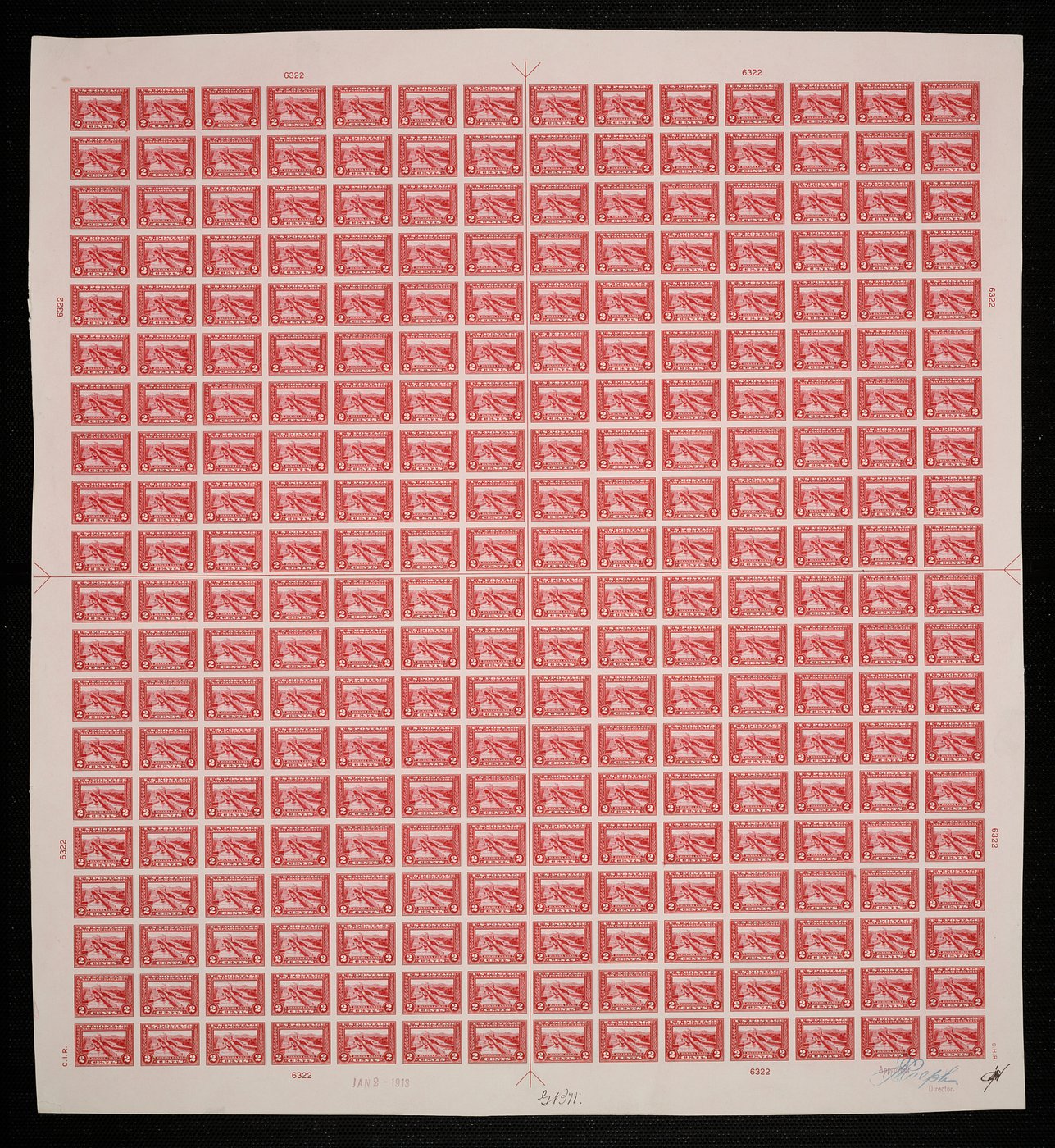
2c Pedro Miguel Locks, Panama Canal plate proof — January 2, 1913
NPM via Smithsonian Open Access (CC0)
Suez Canal aerial view
Generated by Grok Imagine (xAI), prompt: Generate a single 4:3 horizontal image for an educational lesson.
Lesson title: "The Tiny Strips of Water That Run the World" · A few narrow passages control trillions in trade and the power of nation…
Quiz yourself