Geography
·
Why Millions of People Just... Leave
Medium
7 min
Why Millions of People Just... Leave
The invisible forces that uproot entire populations and why you would probably do the same.
Share
Imagine your city's biggest employer shuts down overnight. Then a drought kills the harvest. Then the government starts arresting people who speak up about it. At what point do you pack a bag and go? That question — asked by hundreds of millions of people throughout history — is the entire engine of human migration.
Nobody moves for no reason. Migration is always a calculation, conscious or not, between the pain of staying and the hope of somewhere else. Geographers broke this down into two forces. The things that drive you away from a place are called push factors. The things that draw you toward a new one are pull factors. Simple labels for something that rewires entire civilizations.
Analogy
Think about why people leave a group chat. Sometimes it's because the chat got toxic — drama, constant negativity, someone who won't stop posting unhinged takes at 2am. That's a push. But sometimes you leave because a better, smaller group chat formed with the people you actually like. That's a pull. Usually it's both happening at the same time. Migration works exactly like this, just with higher stakes than muting notifications. People rarely move purely because somewhere is amazing — they move because staying became unbearable AND somewhere else looks better.
So what actually pushes people out? The big ones: war and political violence, economic collapse, environmental disasters, and persecution — religious, ethnic, political. These aren't abstract forces. They're 'my neighborhood is being bombed,' 'I haven't had a steady paycheck in two years,' 'the river that fed our crops dried up.' The push doesn't have to be catastrophic to work. A slow bleed of declining wages, worsening air quality, and creeping authoritarianism can push people just as effectively as a sudden shock. It just takes longer.
Pull factors are the flip side, the magnet. Jobs. Safety. Family who already made the move. Better schools. Political freedom. A climate that isn't hostile to survival. The classic pull in the 20th century was factory work in industrial cities, which is why Detroit went from a small town to a metropolis in a generation, drawing Black Americans out of the Jim Crow South in what historians call the Great Migration. The pull doesn't have to be guaranteed. It just has to be believable. Hope is enough to move people.
Make your call
Back to that opening scenario: your employer closes, the drought hits, the arrests begin. When you finally pack that bag — what's actually driving you out the door? Is it the push, the pull, or something else entirely?
A
The push factors — the bad conditions at home are what force the decision
B
Both push and pull factors working together, always
C
The pull factors — you only move once somewhere better becomes visible
Key Insight
Migration almost never has a single cause. It's always a combination of pushes and pulls stacking on top of each other until the calculation tips. The person who says 'I moved for a job' usually also left behind something that wasn't working. The refugee fleeing war is also pulled toward a specific country because a cousin is already there. The forces work together.
Example
Take Syrian migration after 2011. The push was catastrophic — civil war, barrel bombs, the collapse of basic services. But where people went wasn't random. Turkey, Lebanon, and Jordan absorbed the most because of proximity — the pull of 'close enough to go back someday.' Germany attracted hundreds of thousands because of its economy, its stated welcome policy, and crucially, existing Syrian communities. Same push, different pulls, different destinations. The pattern repeats across every major migration event in history: Irish famine survivors flooding into Boston and New York (existing communities, English language), Mexican workers crossing into California and Texas (geography, agricultural labor demand), Indian and Pakistani immigrants landing in the UK (colonial ties, language). The destination is never random.
That question from the opening — at what point do you pack a bag and go? — turns out to have the same answer every time: when the push and pull tip the calculation past the point of no return. And migration changes the places people leave just as much as the places they arrive. When working-age people leave a struggling region, the region struggles more. Tax base shrinks. Schools close. Businesses follow the people out. Economists call this 'brain drain' when it's skilled workers leaving. Meanwhile, the destination gets a labor force, cultural diversity, and often, over generations, economic growth. The same movement that hollows out one place can build another. Which means migration isn't just a human story. It's a geography story. It literally reshapes the map of where people and power are concentrated.
Sources
Images from Wikimedia Commons. Attribution required by license.
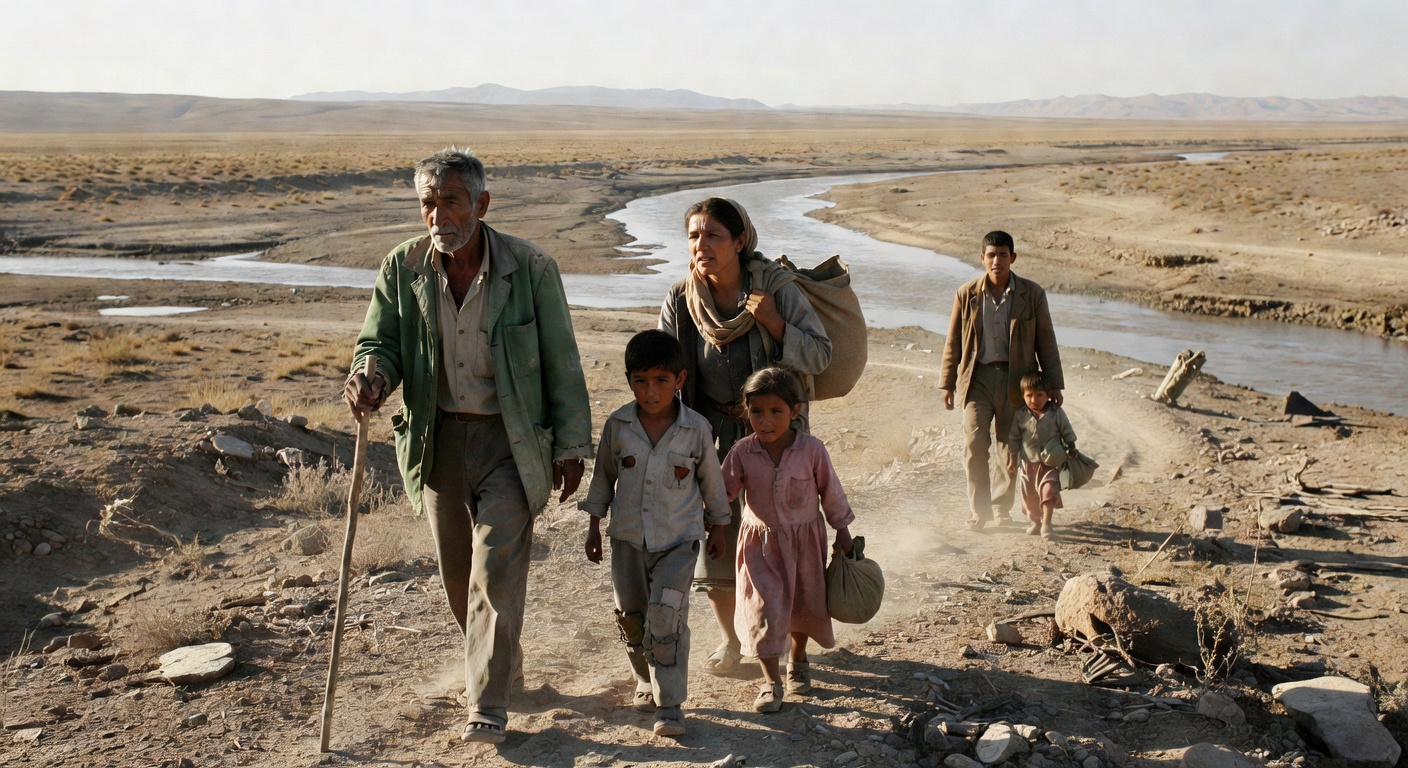
refugee family border crossing
Generated by Grok Imagine (xAI), prompt: Generate a single 16:9 horizontal image for an educational lesson.
Lesson title: "Why Millions of People Just... Leave" · The invisible forces that uproot entire populations and why you would probably…
drought cracked earth farmland
Generated by Grok Imagine (xAI), prompt: Generate a single 4:3 horizontal image for an educational lesson.
Lesson title: "Why Millions of People Just... Leave" · The invisible forces that uproot entire populations and why you would probably …
Quiz yourself