Geography
·
Why Did You Win the Resource Lottery?
Medium
7 min
Why Did You Win the Resource Lottery?
The dirt under your feet decided more about your country's fate than any king or president ever did.
Share
Saudi Arabia sits on 17% of the world's proven oil reserves. It didn't discover oil until 1938. Before that, it was one of the poorest places on Earth. The land didn't change. The geology was always there. What changed was what humans decided to want.
Here's the uncomfortable truth about national wealth: a huge chunk of it was decided before any human being made a single decision. Not by hard work, not by good governance, not by superior culture — but by where tectonic plates crashed, where ancient seas evaporated, and where glaciers happened to scrape millions of years ago. You were born into a country that either won or lost a geological lottery that ran for 4 billion years before you showed up — and just like Saudi Arabia in 1938, the land was always there. What changed was what humans decided to want.
So what exactly is in this lottery? Oil and natural gas — formed from ancient marine organisms compressed over millions of years — ended up concentrated in the Middle East, Russia, and parts of West Africa because of where prehistoric seas existed and how the crust folded afterward. Coal — compressed ancient forests — pooled under Britain, the eastern US, and China, which is not a coincidence if you're trying to explain where the Industrial Revolution happened. Copper, lithium, and rare earth minerals followed their own geological logic, ending up in Chile's Atacama Desert, the Congo Basin, and Inner Mongolia. Nobody planned this. Plate tectonics doesn't care about human borders.
Make your call
Saudi Arabia was one of the poorest places on Earth before 1938 — then oil changed everything. So what's the real prize in the resource lottery? Is it simply having the most valuable resource underground?
A
Yes — the country with the largest reserves wins, because more resource means more wealth
B
Having the resource at the exact moment in history when the world decides it needs it
C
Having a stable government ready to manage resource revenues before discovery
Key Insight
The most important insight in resource geography: the resource itself isn't the prize. The prize is having the resource at the exact moment in history when the world decides it needs it. Coal was worthless before steam engines. Oil was a nuisance before internal combustion. Lithium was a psychiatric medication before electric vehicles. The lottery has a second draw — timing.
Example
Bolivia has the world's largest lithium reserves — roughly 21 million tons sitting under the Salar de Uyuni salt flat. For most of history, this was irrelevant. Then Elon Musk started selling electric cars, every government on Earth announced EV mandates, and suddenly Bolivia is sitting on what some people call 'the new oil.' The geology didn't change. Human demand did. Meanwhile, countries that built their entire economies around coal — think parts of Appalachia or Poland's Silesia region — are watching their geological trust fund slowly become worthless as the world shifts toward other energy sources. The lottery giveth and the lottery taketh away.
And here's where it gets genuinely dark. Resource wealth doesn't automatically make countries rich. Economists have a name for what happens when it goes wrong: the resource curse. The pattern goes like this — a country discovers oil or diamonds or whatever, foreign money floods in, the government gets rich off extraction royalties without needing to tax citizens, and because they don't need citizens to generate revenue, they stop being accountable to them. No taxation without representation works in reverse too: no taxation, no representation. You end up with elites skimming resource wealth while everyone else gets nothing, plus a military to keep it that way. Nigeria, Angola, Equatorial Guinea — all sitting on enormous oil wealth, all with staggering inequality and institutional rot. The resource didn't cause the poverty. But it funded the system that kept people poor.
Key Insight
Countries that had to build wealth through agriculture, manufacturing, and trade had to develop institutions — property rights, contract enforcement, educated workforces — because those things are necessary to make human-driven economies function. Countries that could just pump wealth out of the ground often skipped that step. The resource curse is really an institution problem wearing a geology costume.
The countries that escaped the curse are the interesting ones. Norway discovered North Sea oil in 1969 and immediately did something almost no other petro-state did: they treated it like a finite windfall, not permanent income. They created a sovereign wealth fund — now worth over $1.7 trillion — that invests the oil money globally so that when the oil runs out, the returns keep coming. Botswana found diamonds in 1967, two years after independence, and instead of letting the wealth disappear into elite pockets, they negotiated hard with De Beers and used diamond revenues to build schools and infrastructure. Neither country had magic geography. They had institutions that were functional enough to make a different choice. Which raises the question that geographers and economists have been arguing about for decades: does geography determine your fate, or does it just set the odds?
Sources
Images from Wikimedia Commons. Attribution required by license.
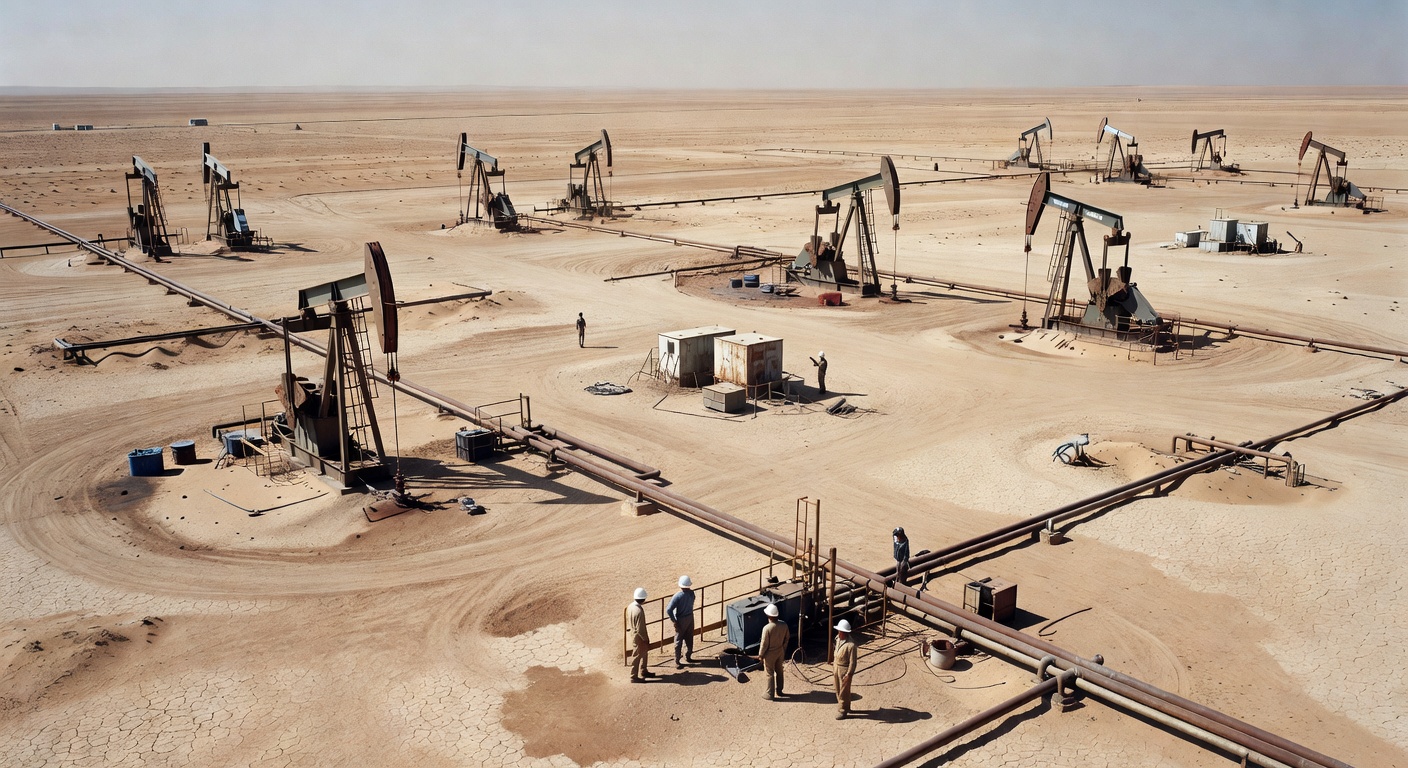
aerial oil field desert
Generated by Grok Imagine (xAI), prompt: Generate a single 16:9 horizontal image for an educational lesson.
Lesson title: "Why Did You Win the Resource Lottery?" · The dirt under your feet decided more about your country's fate than any king…
The table contains a national metallogenic map and three different examples of regional metallogenic relevant sites. More specifically: A) Metallogenic map. Scale: 1: 4 000 000; B) Gold mineralization Sesia-Ossola. Scale: 1: 250 000; C) Geological-mining map 1917 Rio Marina (Elba Isle). Scale: 1: 10 000; D) Metallogenic map Iglesiente-Sulcis. Scale: 1: 250 000. The table is part of the Tematic Atlas realized by the TCI Cartographic Office with CNR - Italian National Research Council (1989-1992)
TCI Cartographic Office · CC BY-SA 4.0
Quiz yourself