Geography
·
Rivers Didn't Just Help Civilization — They Built It
Easy
5 min
Rivers Didn't Just Help Civilization — They Built It
Every empire, every city, every breakthrough in human history started at the water's edge. Here's why that's not a coincidence.
Share
Cairo. Baghdad. London. New York. Beijing. Pick any city that shaped history and zoom out on a map. What do you see every single time? Water. Not just nearby water — they're all sitting right on top of it. That's not luck. That's a pattern. And once you see it, you can't unsee it.
Here's the problem early humans had: survival is a full-time job. Before farming, before cities, before anything we'd recognize as civilization — people spent basically every waking hour finding food. You can't invent writing or build monuments or develop laws when you're constantly on the move chasing animals. You need a reason to stop moving. Rivers gave them that reason.
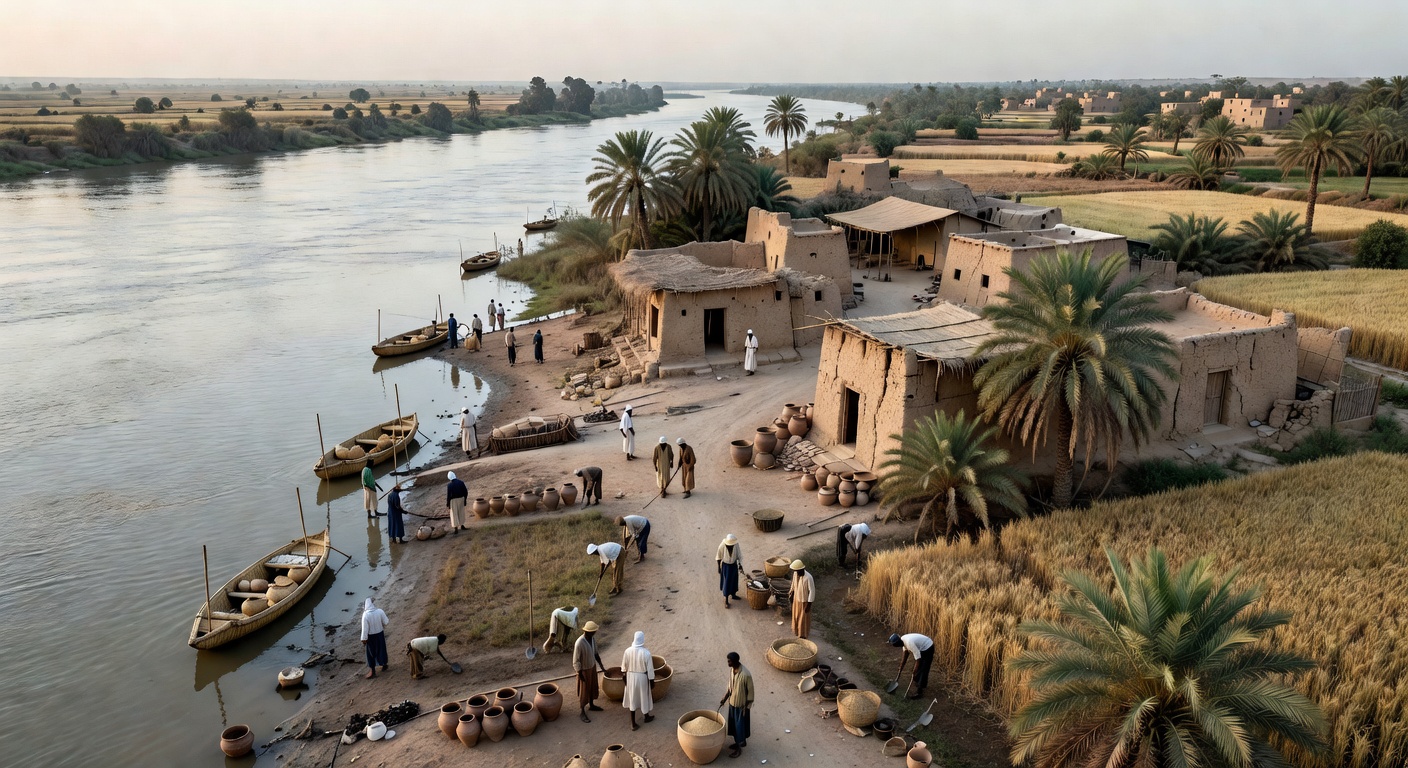
Rivers did something no other geographic feature could: they solved multiple survival problems at once. Drinking water, obviously. But also food — fish don't run away from you. But the underrated part is this: rivers flood. Regularly. Predictably. And when they flood, they deposit a layer of incredibly rich sediment across the surrounding land. The Nile did this every year like clockwork. That sediment turned the desert into farmland. Suddenly you could grow ten times more food than you needed. And the moment you have surplus food, everything changes.
Make your call
Cairo. Baghdad. London. New York. All on rivers. But why rivers specifically — what did they give early humans that no other geographic feature could? Take a guess before the answer lands.
A
Reliable drinking water and fish, which solved the immediate problem of daily survival
B
Regular flooding that deposited nutrient-rich sediment, enabling agricultural surplus
C
Natural defensive barriers that protected early settlements from rival groups
Key Insight
Surplus food is the unlock code for civilization. When not everyone has to farm to survive, some people can become builders, priests, soldiers, traders, and thinkers. Every human achievement you've ever admired — art, science, philosophy, architecture — was only possible because someone else grew enough food to feed the person doing it.
Every single hour Aristotle spent thinking about logic was an hour someone else spent farming so he didn't have to. The river made that trade possible. It produced enough food that thousands of people could stop growing it — and start doing everything else. That's how you get philosophers in ancient Greece and astronomers in Mesopotamia.
But rivers weren't just pantries. They were highways. Before roads, before railways, before anything — moving heavy stuff overland was brutal. A river let you load goods onto a boat and float them hundreds of miles with minimal effort. The Mesopotamians used the Tigris and Euphrates to trade across an entire region. The Egyptians moved the massive stones for their monuments using the Nile. Rivers connected settlements into networks, and networks are where trade happens. And trade is where ideas, technologies, and cultures mix and accelerate each other.
Example
Look at the four cradles of civilization — the places where complex human society independently emerged: Mesopotamia (between the Tigris and Euphrates), Egypt (the Nile), the Indus Valley (the Indus River), and ancient China (the Yellow River). Four different continents. Four different cultures. Zero contact with each other. All four independently figured out that the river was the place to be. When four completely separate groups of humans all arrive at the same answer independently, that's not culture — that's geography forcing the outcome.
Key Insight
Geography doesn't determine destiny — but it stacks the deck hard. The civilizations that thrived weren't necessarily smarter or more ambitious. They just started the game with better geography. A river valley in 3000 BCE was like getting a head start in a race everyone else was running from scratch.
Here's the part that hasn't changed: most of the world's biggest cities are still river cities. London on the Thames. Paris on the Seine. Shanghai on the Yangtze. The rivers aren't the point anymore — we have pipes and trucks and cargo ships — but the cities are still there because infrastructure, culture, and population built up around the water over thousands of years and never left. That pattern from the hook — Cairo, Baghdad, London, New York, all on water — isn't luck or coincidence. It's the echo of decisions made thousands of years ago by people standing at a riverbank, thinking: yeah, this is the spot.
Related threads
Geography
·
Every City Was Built Next to Water
Every City Was Built Next to Water
Sources
Images from Wikimedia Commons. Attribution required by license.
ancient river civilization aerial
Generated by Grok Imagine (xAI), prompt: Generate a single 16:9 horizontal image for an educational lesson.
Lesson title: "Rivers Didn't Just Help Civilization · They Built It"
Pont du Gard, France — 1926
Smithsonian American Art Museum, Bequest of Emily Finch Gilbert through Julia Post Bastedo, executor via Smithsonian Open Access (CC0)
From the web: Assyrian Trader Colony Bronze Age terracotta boat shaped ritual vessel. This cult pot is boat shaped with an animal head at the front. Inside the vessel is a model of a temple and goddess. The deities associated with the ritual vessel were associated with trade and transportation in Ancient Mesopotamia and Summerian literature. The vessel signifies a religious river trip. - 19th century BC - Kültepe Kanesh - Museum of Anatolian Civilisations, Ankara, Turkey.
The museums speaks of a "sandal shaped" object, I think a mistake was made in the translation and used "boat" or "vessel".
Dosseman · CC BY-SA 4.0
Quiz yourself