Economics
·
The Number That Runs the World
Medium
6 min
The Number That Runs the World
One statistic shapes every government decision on Earth, but it was never designed to measure what we think it does.
Share
A hurricane hits. Thousands of homes are destroyed. Cleanup crews mobilize, contractors rebuild, insurance companies pay out billions. According to the most powerful economic metric on the planet — the economy just got better. That's not a bug. That's how GDP works.
GDP — Gross Domestic Product — is the total value of everything a country produces in a year. Every car built, every coffee sold, every haircut given, every app downloaded. Add it all up and you get one number that supposedly tells you how well a country is doing.
Governments use it to decide spending. Central banks use it to set interest rates. Investors use it to move trillions of dollars. If GDP is growing, everyone breathes easy. If it shrinks for two quarters in a row, it's officially called a recession — and people panic.
One number. Enormous consequences. So it's worth asking: what exactly is it counting?
Analogy
Think about your phone's year-end screen-time report. It tells you how many hours you spent, which apps ate your week, how many pickups a day. It's a real, accurate measurement of your activity.
But it doesn't tell you whether any of those hours were good hours. It doesn't know if you were video-calling your grandmother or doom-scrolling at 2 a.m. It just counts activity.
GDP is a screen-time report for an entire economy. It measures activity — transactions, production, money changing hands. It is genuinely useful data. But it's measuring the hours, not the life.
Here's how economists actually calculate it. There are three ways, and they all give the same answer (in theory).
The most common: add up all spending in the economy. What consumers buy. What businesses invest. What the government spends. Plus exports, minus imports. That's it. GDP = Consumer spending + Business investment + Government spending + (Exports − Imports).
Every dollar someone spends is a dollar someone else earned producing something. So you can also add up all incomes. Or add up the value added at each stage of production. Three different angles, same number. The economy as one giant accounting identity.
Make your call
Back to that hurricane from the opening: thousands of homes destroyed, billions spent on cleanup and rebuilding. What does GDP register when all that spending hits the books?
A
GDP falls — the destruction wipes out more wealth than the rebuilding creates
B
GDP rises — the cleanup and reconstruction count as economic activity
C
GDP stays flat — destruction and rebuilding cancel each other out
Key Insight
GDP measures the value of transactions — not the value of outcomes. A country can grow its GDP by building more prisons, selling more cigarettes, or cleaning up more oil spills. It counts all of it equally. Growth isn't the same as progress.
And here's where it gets genuinely weird. GDP misses enormous amounts of real value.
You cook dinner at home — not counted. You help a friend move — not counted. You raise your kids — not counted. You volunteer, mentor someone, fix your own car — none of it shows up. But hire a chef, a moving company, a nanny, a mechanic? Suddenly it counts.
GDP only sees what passes through markets. The moment money changes hands, it exists. The moment it doesn't, it's invisible. Which means some of the most important things people do — care work, community, creativity that isn't monetized — are statistically worthless to the metric that runs the world.
Example
In 2014, the UK revised its GDP upward by including estimates of drug dealing and prostitution in its calculations — because these are real economic activity, just illegal. The economy 'grew' without a single additional legal transaction happening.
Meanwhile, if every parent in the country decided to quit their jobs and raise their own children instead of paying for childcare, GDP would fall — even though the same amount of care is happening, and arguably more of it.
This is exactly what the hurricane in the opening reveals: GDP rose after the storm, not despite the destruction, but partly because of it. This isn't a flaw someone overlooked. GDP was designed in the 1930s to measure wartime production capacity. It was a tool for a specific job. We just never stopped using it after that job ended.
Key Insight
GDP per capita — total GDP divided by population — is the closest thing economists have to a shorthand for living standards. It's imperfect, it ignores inequality, and it misses wellbeing entirely. But when it's very low, people are almost certainly struggling. It's a floor, not a ceiling — useful for spotting disasters, not for measuring flourishing.
So why do we still use it?
Because it works — for what it was designed to do. GDP reliably tracks economic activity. It tells you if the engine is running faster or slower. It's comparable across countries and across time. And in a crisis — a recession, a pandemic, a war — it's the fastest signal you have that something is going wrong or right.
The problem isn't GDP. The problem is treating it like it's the whole story. Countries like New Zealand and Bhutan have started measuring 'wellbeing budgets' and 'gross national happiness' alongside GDP. The UN has the Human Development Index, which folds in education and life expectancy.
None of them have replaced GDP. Because one number is convenient, and convenient wins. But the next time someone tells you the economy is growing, the right follow-up question is: growing for whom, and counting what?
Sources
Images from Wikimedia Commons. Attribution required by license.
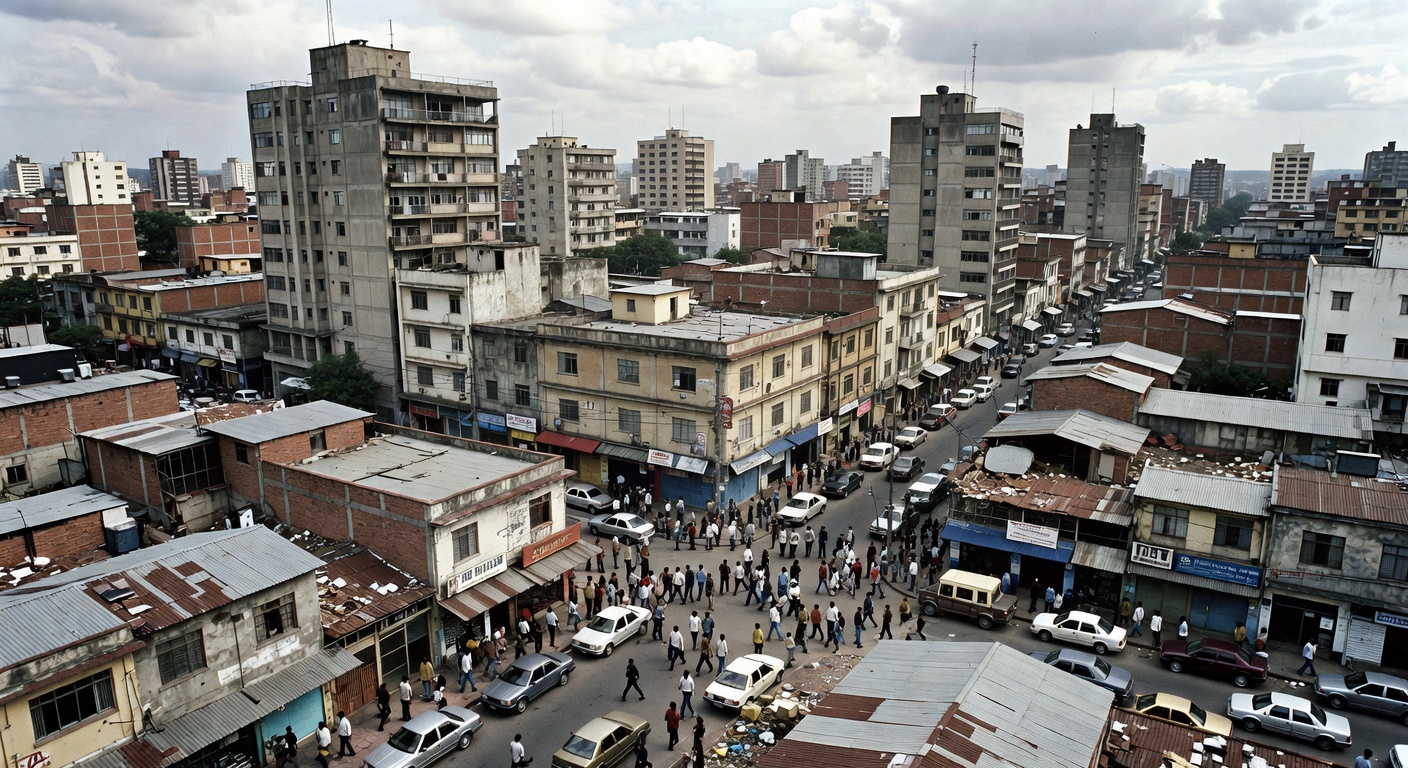
city skyline aerial
Generated by Grok Imagine (xAI), prompt: Generate a single 16:9 horizontal image for an educational lesson.
Lesson title: "The Number That Runs the World" · One statistic shapes every government decision on Earth, but it was never designed t…
Title: Murray M. Stewart. Economist, Dept. of Agrig.
Abstract/medium: 1 negative : glass ; 4 x 5 in. or smaller
Harris & Ewing, photographer · Public domain
Quiz yourself