Economics
·
Why Countries Don't Just Make Everything Themselves
Easy
5 min
Why Countries Don't Just Make Everything Themselves
The surprisingly simple idea that explains almost all of global trade
Share
If the US is better than Mexico at making literally everything — better factories, better technology, better workers — why would it ever buy anything from Mexico? The answer breaks your brain a little.
Your first instinct is probably: trade with other countries when they can make something you can't. Makes sense. But that's not actually how trade works — and it's not why global trade exploded into a $30 trillion-a-year machine. The real reason is weirder and more powerful than that. It's not about who's better at something. It's about what you give up to do it.
Analogy
Imagine you're insanely good at your job — a software engineer making $200/hour. You're also, weirdly, a faster typist than your assistant. Should you type your own emails? Obviously not. Every hour you spend typing is an hour you're not billing $200. Your assistant types slower, sure, but their time costs $20/hour. You're better at typing. But they have the comparative advantage — because what they give up to type is way less than what you give up. That's the whole idea. It's not about who's best. It's about who sacrifices the least to do it.
Make your call
Back to the opening question: if the US is genuinely better than Mexico at making everything, should it ever buy anything from Mexico? What's your instinct?
A
No — if you're better at everything, doing it all yourself always makes more sense
B
Yes — because what you give up to produce something matters more than how good you are at it
C
Yes — but only for things the US physically can't produce, like certain crops
Economists call this comparative advantage. Ignore the jargon. Here's what actually matters: every choice has an opportunity cost — the thing you give up to do it. A country should make the things where its opportunity cost is lowest, and trade for everything else. Even if it's worse at making those other things. Even if it could theoretically do it all.
Example
Brazil is incredible at growing coffee. The climate, the soil, the expertise — it all lines up. Could Norway grow coffee? Technically yes, in expensive greenhouses. But to do that, Norway would have to pull resources away from things it's brilliant at — like oil production and shipping. The opportunity cost of Norwegian coffee is enormous. So Norway buys Brazilian coffee, Brazil buys Norwegian oil equipment, and both countries end up with more of everything than if they'd tried to go it alone.
Key Insight
The key insight: trade isn't about who's best at what. It's about the fact that when everyone focuses on what they give up the least to produce, the total amount of stuff in the world goes up. Specialization creates wealth that didn't exist before.
That's the answer to the opening puzzle: two countries can trade and both come out ahead — even if one country is better at producing literally everything. This isn't a deal where one side wins and one loses. It's a deal where the total output of both countries increases because each stopped wasting resources doing things they're relatively bad at. That's not intuitive. We're wired to think of competition as zero-sum. Trade isn't.
This is also why your phone was assembled in Vietnam, the chips inside it were designed in California, the rare minerals came from the Democratic Republic of Congo, and the software was written across three continents. Not because any one country couldn't do the whole thing — but because this arrangement produces more, faster, cheaper, than any single country trying to own the entire process. The global supply chain is just comparative advantage scaled up to planetary size.
Key Insight
But here's the tension nobody talks about: comparative advantage explains why trade makes countries richer on average — but it doesn't say who inside the country gets that wealth. Some industries boom. Others get wiped out. The gains are real. So is the disruption. That's the part politicians fight about.
Sources
Images from Wikimedia Commons. Attribution required by license.
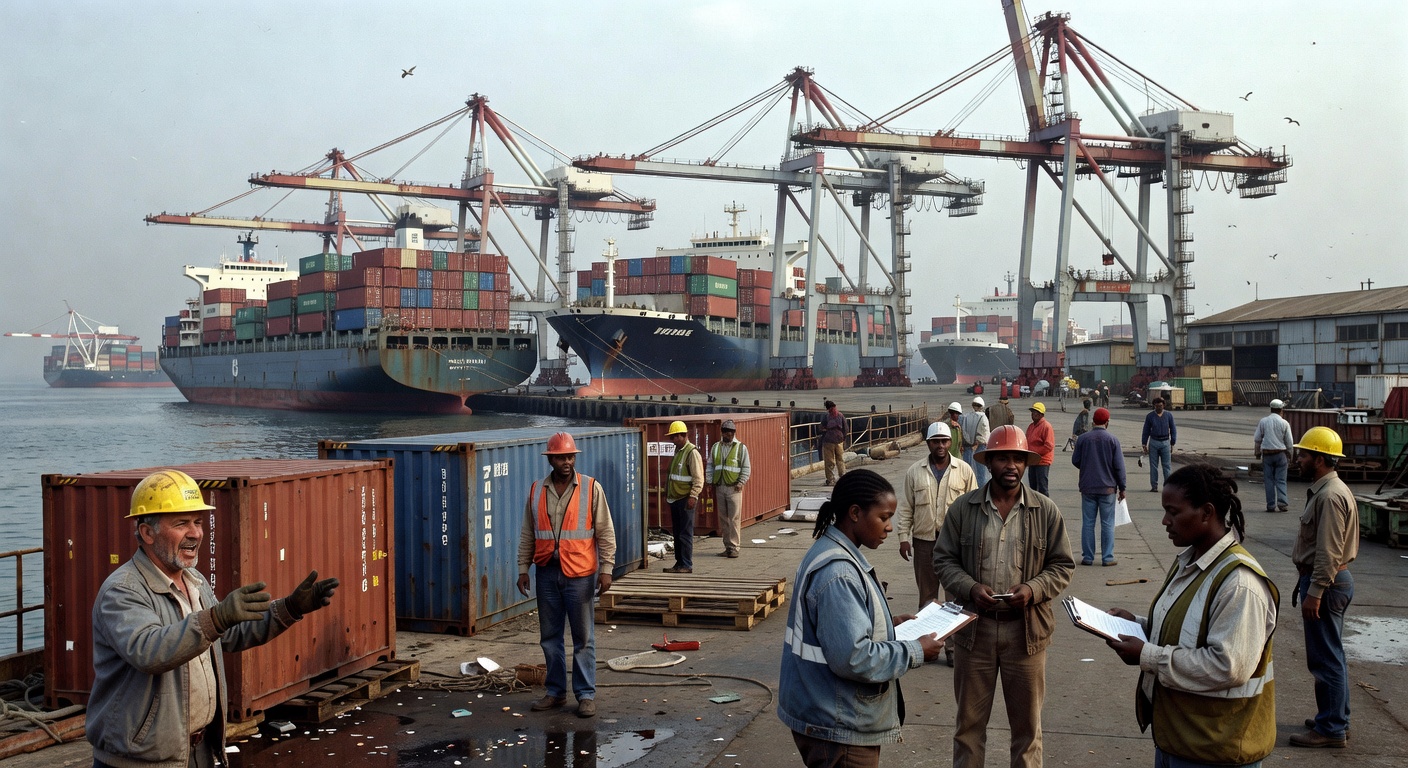
container ships port trade
Generated by Grok Imagine (xAI), prompt: Generate a single 16:9 horizontal image for an educational lesson.
Lesson title: "Why Countries Don't Just Make Everything Themselves" · The surprisingly simple idea that explains almost all of global…
Boy at Loom, Cotton Mill, Indiana, 1908 — ca 1906-1918
NMAH via Smithsonian Open Access (CC0)
Boy at Loom, Cotton Mill, Indiana, 1908 — ca 1906-1918
NMAH via Smithsonian Open Access (CC0)
Quiz yourself