Economics
·
Money Isn't Real (And That's the Point)
Easy
5 min
Money Isn't Real (And That's the Point)
The thing you work for every day is held together entirely by collective belief.
Share
A piece of cotton and linen with some ink on it is worth nothing. So why would you trade an hour of your life for one? And why would someone else trade food, shelter, or labor for it in return? The answer breaks your brain a little — and explains everything about how the modern world actually runs.
For most of human history, if you wanted something, you had to find someone who had it AND wanted what you had. A farmer with wheat who needed shoes had to find a shoemaker who happened to want wheat. Right now. In the right quantities. Economists call this the 'double coincidence of wants,' but you can just call it an absolute nightmare. Trade barely worked. Economies barely grew. Then someone had an idea that changed everything: what if we all agreed that some object, a shell, a coin, a piece of paper, counted as value itself? Not because it was useful. Just because we all said so.
Analogy
Think about how Venmo works. When your friend pays you back for dinner, no physical thing moves. No gold changes hands. A number goes up in an app. You trust that number because you trust that Venmo is real, that the bank behind it is real, that the dollar is real. But strip it all back and what you're trusting is a shared story — a collective agreement that these numbers mean something. That cotton-and-linen note in your wallet? Money has always worked exactly like this — the reason you'd trade an hour of your life for it is the same reason Venmo works: shared belief. The material is almost irrelevant. The agreement is everything. This is why Bitcoin and a $20 bill are more similar than they seem: both are worth exactly what people agree they're worth, and zero if that agreement collapses.
So money is a technology — one of the most powerful ever invented. It solves the coordination problem of trade by giving everyone a common language of value. It does three things that nothing else does quite as well: it's a medium of exchange (you can swap it for anything), a store of value (you can save it and use it later), and a unit of account (you can price everything in it and compare apples to, literally, oranges). Lose any one of those three and you don't really have money anymore. Hyperinflation destroys the store of value — suddenly people in Venezuela or Weimar Germany were using cash as wallpaper because it was cheaper than buying wallpaper.
Key Insight
Money isn't wealth. It's a claim on wealth. The actual stuff — food, shelter, labor, time, land — that's real. Money is just the token you use to call in your claim. When a country 'prints more money' without creating more real stuff, the tokens multiply but the stuff doesn't. So each token buys less. That's inflation, in one sentence.
Make your call
Before we go further: where does most of the money in circulation actually come from? Take a guess — your intuition here is worth testing.
A
Governments print it through their central banks
B
It comes from gold and other physical reserves held in vaults
C
Commercial banks create it every time they issue a loan
Most of the money in existence right now wasn't printed by a government. It was created by banks. When you deposit $1,000 in a bank, the bank doesn't just sit on it. It lends most of it out — say, $900 — to someone else. That person deposits it in another bank, which lends out $810. And so on. Your original $1,000 has now become $1,000 + $900 + $810 + ... in total deposits across the system. The same dollars are being counted multiple times. Banks don't just store money — they manufacture it, every time they make a loan.
Picture a chain. You deposit $1,000. Bank A keeps $100 (its 'reserve') and lends out $900. The borrower spends that $900 at a store. The store deposits $900 in Bank B. Bank B keeps $90, lends out $810. That $810 gets spent and deposited in Bank C. Keep going. Your original $1,000 deposit has spawned roughly $10,000 in total money circulating through the system. The ratio of how much gets lent versus kept is called the reserve ratio, and it's the dial that controls how much money the banking system creates.
Key Insight
When you take out a loan, the bank doesn't hand you money it already had. It types a number into a computer and your account balance goes up. That new money did not exist five minutes ago. Banks create money by issuing credit. And when you repay the loan, that money is destroyed. The money supply literally expands and contracts with borrowing. This is not a conspiracy theory — it's how central banks describe their own system.
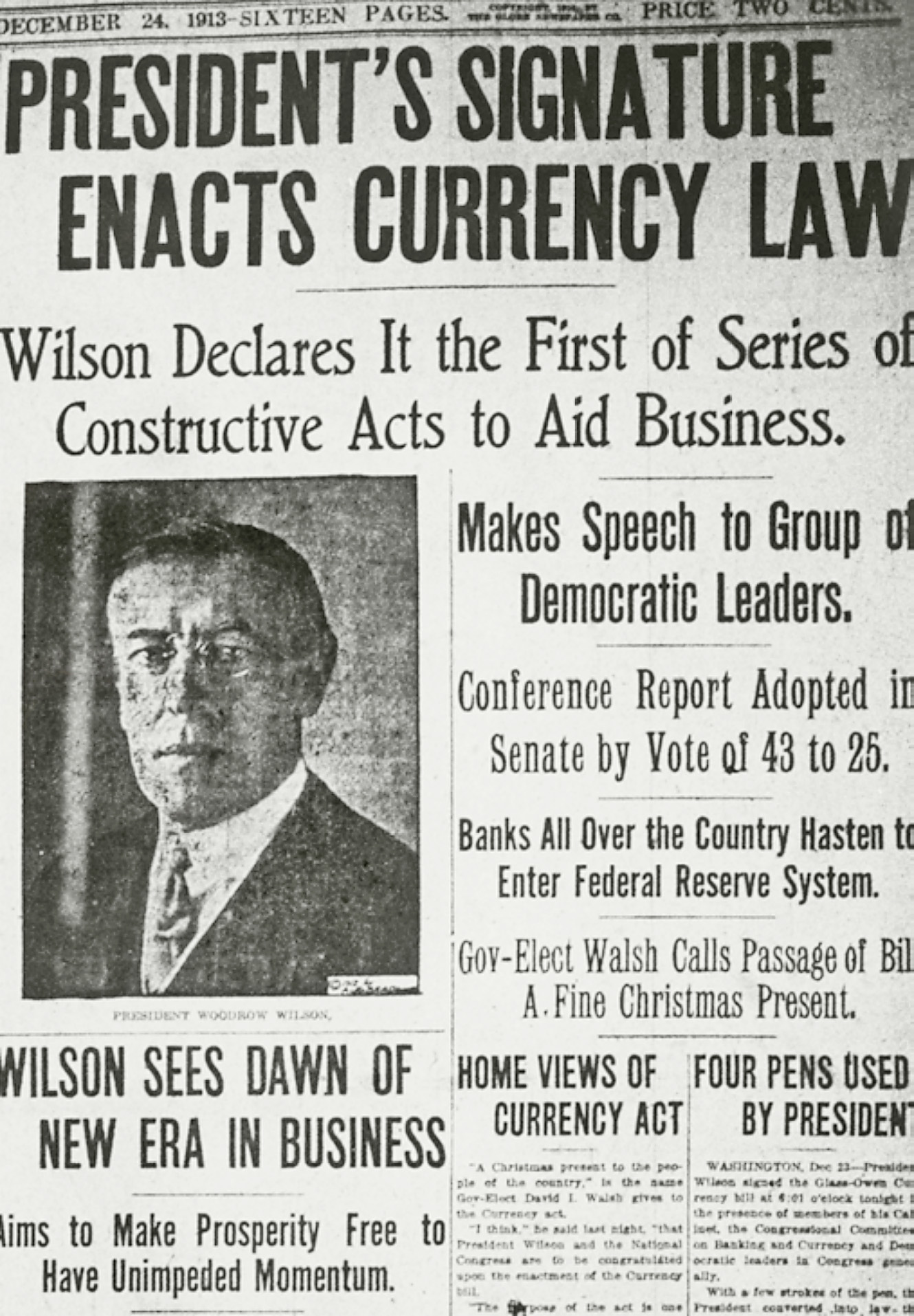
So who makes sure this doesn't spiral into chaos? Central banks like the Federal Reserve in the US sit at the top of the system. They control the base money supply, set the interest rate that banks charge each other, and act as the 'lender of last resort' when banks get into trouble. They're the reason a bank run (everyone demanding their deposits back at once) doesn't automatically collapse the entire economy. They're also the reason that when things go wrong on a massive scale, as in 2008 and 2020, governments can flood the system with liquidity almost instantly. The whole architecture is designed to keep the shared belief alive. Because the moment enough people stop believing, the whole thing unravels.
Sources
Images from Wikimedia Commons. Attribution required by license.
Description: Newspaper clipping USA, Woodrow Wilson signs creation of the Federal Reserve.
Source:
Date: 24 December 1913
Wikimedia Commons · Public domain
German Papiermark of the Weimar Republic, post World War I hyperinflation era (1921–24).
Reichsbankdirektorium Berlin · Public domain
Quiz yourself