Economics
·
Why Prices Rise
·
Distributional effects
Medium
7 min
Inflation's Secret Winners and Losers
Inflation quietly redistributes purchasing power from savers to debtors.
Share
Your grandma has $50,000 in a savings account earning 1% interest. Inflation runs at 6% for three years. She never lost a dollar. Her balance kept climbing. And somehow, she lost $8,000.
Inflation doesn't hit everyone equally — and that part rarely gets explained upfront. When prices rise, some people get quietly crushed. Others — and this is the part that feels almost unfair — actually come out ahead. The same inflation rate, applied to the whole economy, produces completely opposite outcomes depending on one thing: whether you're holding money or owing it.
Example
Meet two people: Maya and Jordan.
Maya worked hard her whole career, saved diligently, and retired with $200,000 sitting in a fixed-rate savings account paying 1.5% annually. She lives off the interest plus a fixed pension of $2,800 a month — set when she retired five years ago and never adjusted.
Jordan is 29, has $12,000 in student loans and a $280,000 mortgage, both locked in at fixed interest rates from three years ago.
Inflation hits 7% and stays there for two years.
Maya's savings earn 1.5% while inflation runs at 7%. In real terms — meaning, in actual purchasing power — her $200,000 is shrinking by about $11,000 a year. Her pension buys less every month. The grocery bill she's been managing on $400 a month now costs $480. Her income didn't move. The world got more expensive around her.
Jordan? Jordan's wages went up 6% because his employer had to compete for workers in an inflationary environment. His loan payments stayed exactly the same — fixed contracts don't care about inflation. The $1,400 monthly mortgage payment that used to feel heavy now feels lighter against his bigger paycheck. In real terms, his debt is shrinking while he sleeps.
Make your call
Your grandma's balance kept climbing, yet she lost $8,000 in real terms. Who actually came out ahead while she lost ground — and why?
A
People who owed fixed debts, because inflation shrank what they had to repay in real terms
B
People who held cash savings, because their balances nominally increased each year
C
Everyone lost equally — inflation is a rising tide that hits all boats the same way
This is the answer to your grandma's $8,000 — and the core mechanism behind it: inflation is a transfer. Not a tax that the government collects, not a fee you see on a receipt. A silent, invisible redistribution that moves real purchasing power from people who hold money to people who owe it.
The reason is straightforward once you see it. A debt is a fixed number — say, $10,000. If inflation runs at 10%, that $10,000 is worth 10% less in real goods and services than it was a year ago. The debtor still pays back $10,000 in nominal dollars, but those dollars buy less. The lender — the person who handed over real purchasing power — gets back less real value than they lent. The debtor wins. The creditor loses. Nobody made a decision to transfer wealth. Inflation just did it automatically.
Key Insight
Inflation is a tax on holding money — and a subsidy on owing it. Savers pay it. Debtors collect it. The transaction is invisible, but it's real.
Example
Scale this up and it gets genuinely wild.
The U.S. government is the world's largest debtor. In 2021, total federal debt crossed $28 trillion. When inflation ran above 7% through 2022, the real value of that debt fell by trillions of dollars — not because anyone paid it down, but because the dollars it was denominated in became worth less. Bondholders — pension funds, foreign governments, retirees who bought Treasury bonds expecting stable returns — absorbed that loss in purchasing power. The government, as debtor, came out ahead.
This is not a conspiracy. It's just math. But it does explain why governments throughout history have sometimes been suspiciously relaxed about letting inflation run a little hot. John Maynard Keynes noted in 1919 that inflation is a way governments can confiscate wealth secretly and unobserved — and that not one man in a million can diagnose it while it's happening. The mechanism hasn't changed.
The cruelest part of this transfer is who it tends to hit hardest. Wealthy people typically hold a smaller share of their net worth in cash and fixed-income assets — they own stocks, real estate, businesses, things whose prices tend to rise with inflation. Their wealth inflates alongside everything else.
People with less wealth often hold a larger share in cash savings, checking accounts, or fixed pensions. They're the ones whose purchasing power erodes fastest. A retiree on a fixed income has no lever to pull. A 25-year-old with a mortgage and rising wages has two levers working in their favor simultaneously.
This is why economists sometimes describe moderate inflation as a redistribution from old to young, from savers to borrowers, from creditors to debtors. It's not always intentional. But it's always happening.
One last thing worth sitting with: this mechanism runs in reverse during deflation. When prices fall, debtors get crushed — they're paying back loans in dollars that are worth more than when they borrowed them. Creditors and savers win. Which is part of why central banks are so paranoid about deflation and willing to tolerate a little inflation. A world where debtors slowly win is uncomfortable. A world where debtors suddenly can't repay is a financial crisis.
Next up: what happens when this mechanism stops being subtle. When inflation doesn't transfer wealth quietly — it destroys it outright. That's hyperinflation, and the stories are genuinely hard to believe.
Related threads
Economics
·
Why Prices Rise
When All the Forces Hit at Once
Economics
·
Why Prices Rise
So You Think You Understand Inflation
Economics
·
Supply and Demand
Why Everything Costs What It Does
Sources
Images from Wikimedia Commons. Attribution required by license.
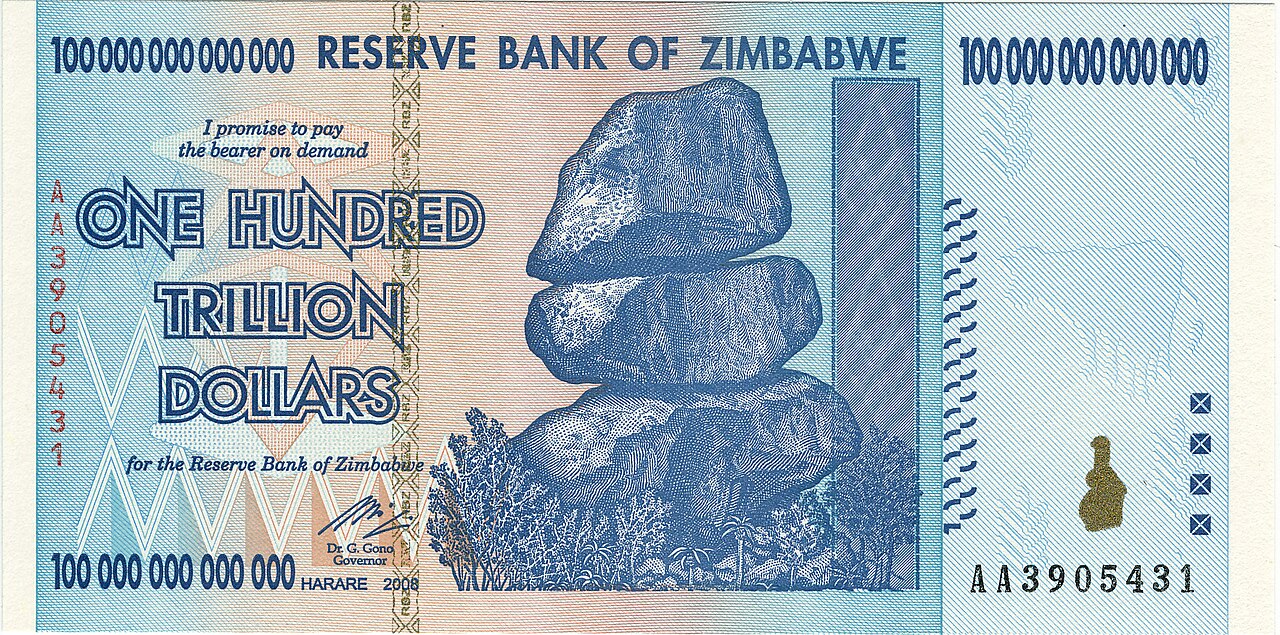
Zimbabwean $100 trillion banknote, 2009 — the largest-denomination bill ever printed by a recognized government
Reserve Bank of Zimbabwe via Wikimedia Commons (Public Domain)
Loan made by The Desloge Lead Company to M.S. Eaton, in the amount of $250. Personal property offered as collateral: 2 horses. This mortgage includes authorization to sell said goods with published ten day notice upon default.Title: Chattel mortgage signed M.S. Eaton, Bonne Terre, St. Francois County, March 6, 1883
Eaton, M.S. · Public domain
Main Concourse ad to get people to trade their "war savings stamps" in for treasury certificates.
Unknown authorUnknown author · Public domain
Quiz yourself