Economics
·
Why Prices Rise
·
Central bank tools
Medium
7 min
The Two Levers That Control Inflation
The second tool the Fed reaches for when interest rates hit zero — and why it has no hard floor.
Share
It's 2022. Inflation hits 9%. The Fed's response? They make borrowing more expensive — 11 times in a row. Prices eventually fall. But in 2008, they tried the same thing and it did almost nothing. So they invented an entirely new tool on the fly. Same institution. Same problem. Completely different playbook. Why?
The Federal Reserve — and every major central bank — has one core job: keep inflation around 2% without tanking the economy. Too much inflation, people's money loses value. Too little, the economy stagnates. It's a tightrope, and they walk it with two tools.
The first tool is the one you've probably heard of: interest rates. The second is something most people have never thought about: the Fed's balance sheet. These tools work through completely different mechanisms, they're deployed in different situations, and understanding both is the difference between actually understanding monetary policy and just nodding along when you hear 'the Fed raised rates again.'
Here's how interest rates work. The Fed sets something called the federal funds rate — the rate at which banks lend money to each other overnight. That might sound obscure, but it cascades through the entire economy within weeks.
When the Fed raises this rate, borrowing gets more expensive everywhere. Your mortgage rate goes up. Business loans get pricier. Credit card APRs climb. Suddenly, the family that was going to buy a house decides to wait. The startup that was going to expand decides to hold off. The consumer who was going to finance a car thinks twice.
Less borrowing means less spending. Less spending means less demand. Less demand means — if you've been following this unit — less upward pressure on prices. The demand-pull inflation you read about on Day 2 starts to cool. That's the mechanism. The Fed makes money more expensive to borrow, so people borrow less of it, so less money chases the same goods.
Make your call
Same institution, same inflation problem — but in 2008 the Fed's go-to tool was essentially useless. What had changed? Why did raising and lowering interest rates stop working?
A
Interest rates had already been cut to zero, so there was nowhere left to go — the tool had hit its hard floor
B
Congress had temporarily suspended the Fed's rate-setting authority during the crisis
C
Inflation in 2008 was caused by too little spending, so rate cuts would have made things worse
This worked beautifully for decades. Then 2008 happened.
The financial crisis was so severe that the Fed cut rates all the way to zero — as low as they can go without going negative. And the economy still barely moved. Banks weren't lending. Businesses weren't investing. Consumers were terrified. The normal transmission mechanism was broken: you can make borrowing free, but you can't force anyone to borrow.
This is the problem economists call the 'zero lower bound.' When rates hit zero, the first tool runs out of road. So the Fed, under Ben Bernanke, did something it had never done at scale before. It went shopping.
Quantitative easing — QE — sounds technical but the core idea is almost embarrassingly simple: the Fed creates new money electronically and uses it to buy financial assets, mostly government bonds and mortgage-backed securities, directly from banks and investors.
When the Fed buys a $1 million bond from a bank, that bank now has $1 million in cash sitting in its reserve account instead of a bond. The bank needs to do something with that cash — leaving it idle earns almost nothing. So it lends it out, invests it, or buys other assets. That pushes down long-term interest rates (because more money is chasing bonds, driving up bond prices and down yields). Lower long-term rates make mortgages cheaper, business investment more attractive, and stock prices higher — which makes people feel wealthier and more willing to spend.
Between 2008 and 2014, the Fed's balance sheet went from roughly $900 billion to $4.5 trillion. They did it again in 2020 when COVID hit, expanding to nearly $9 trillion. That is an almost incomprehensible amount of new money entering the financial system.
The 2022 inflation fight shows both tools working in tandem — and it's worth walking through exactly how.
When inflation hit 9.1% in June 2022 (the highest since 1981), the Fed did two things at once. They raised interest rates aggressively — from near zero to over 5% in about 18 months, the fastest rate-hiking cycle in 40 years. But they also started quantitative tightening: letting bonds on their balance sheet mature without replacing them, effectively shrinking the money supply.
That's the answer to why 2022 and 2008 demanded completely different playbooks: in 2022, rates had room to move and both levers were available; in 2008, rates hit zero and the Fed had to invent its way out with balance-sheet policy. The rate hikes slowed borrowing immediately. The balance sheet reduction was slower and quieter, but it pulled hundreds of billions out of the financial system over time. By late 2023, inflation had dropped back toward 3%. Whether that was mostly the rate hikes, the QT, or just supply chains fixing themselves is something economists are still arguing about. But the point is: both levers moved.
Key Insight
Most people hear 'the Fed acted' and picture one thing: a rate change. But since 2008 the Fed has had a second lever — balance-sheet policy — that works through a completely different channel and has no hard floor. Knowing which one got pulled, and why, is what separates understanding monetary policy from just nodding at the news.
Sources
Images from Wikimedia Commons. Attribution required by license.
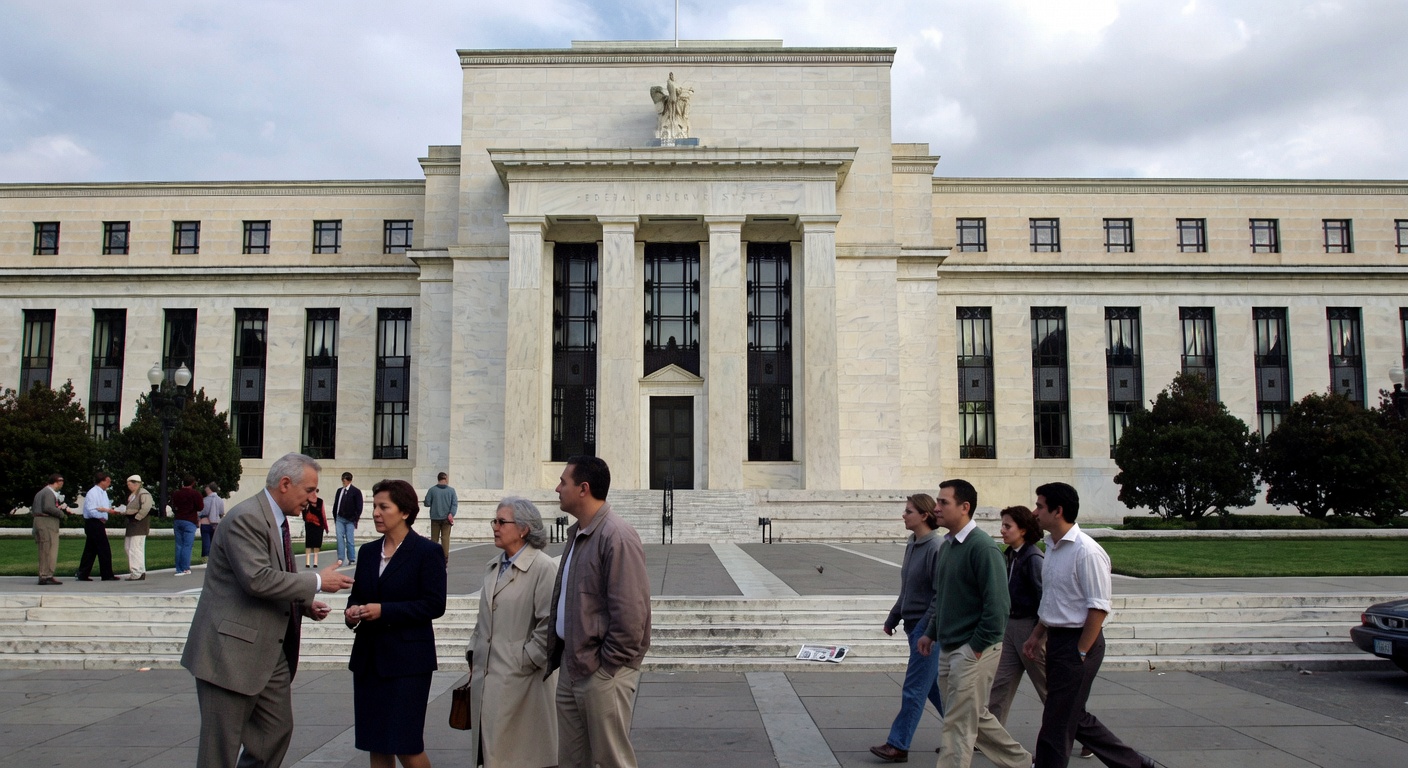
Federal Reserve building Washington
Generated by Grok Imagine (xAI), prompt: Generate a single 16:9 horizontal image for an educational lesson.
Lesson title: "The Two Levers That Control Inflation" · Central banks have two very different weapons against inflation, and most peo…
Title: Illinois Agricultural Association record (microform)
Identifier: 5060538.1931-1934
Year: 1931- December 1934 January 1931- December 1934 (Jan0s)
Authors: Illinois Agricultural Association; Illinois Agricultural Association. Record
Subjects: Agriculture
Publisher: Mendota, Ill. : The Association
Contributing Library: University of Illinois Urbana-Champaign
Digitizing Sponsor: University of Illinois Urbana-Champaign
View Book Page: Book Viewer
About This Book: Catalog Entry
View All Images: All Images From Book
Click here to view book online to see this illustration in context in a browseable online version of this book.
Text Appearing Before Image:
I. A. A. Record—March, 1934 IS ».. ■*:. County Recorders Are 5^ . X Opposing Fee Bill Letter to Farm Bureau Presi- dents Cites Facts About Measure Opposition chiefly from county re- corders resulted in failure of the bill to permit chattel mortgages to be filed at low cost, to receive the necessary two-thirds vote in the House at Springfield on Feb. 21. County re- corders are objecting to the measure on the ground that their fees will be reduced. The following facts should be kept in mind, John C. Watson, director of taxation, stated in a recent letter to County Farm Bureau presidents: ' 1. Eighty-five counties of the state ~all those of less than 60,000 popu- lation—combine the offices of circuit clerk and recorder. If the proposed bills are enacted, all such offices will continue to collect the usual fees of the circuit clerk, both for county and for other services. : ,... > ■ S^^^ • ,2./All recorders* offices, whether combined with the office of circuit clerk or not, will continue to collect the usual fees for recording all kinds of real estate deeds, all trust deeds and mortgages securing loans on real estate, and probably most chattel mortgages involving substantial sums. ' •;• •; .■•••',• ' ' • •■ !• >■.'••' ' Bills Amended ; S. The Devine bills have been amended to provide a filing fee of 50 cents instead of 25 cents, as originally drawn, and retain the fee of 25 cents for certifying a carbon copy of the chattel mortgage, which will probably usually be requested. The combined filing and certifying fee of 75 cents will be mostly net, as indexing and other costs will be slight, and index- ing saves the cost of about ten cents per page for purchasing the usual chattel mortgage record book. Such net fees should exceed the net profits from all short form chattel mortgages for recording which fees usually vary from 75 to 90 cents. 4. Under the new banking regula- tions, it appears that, much more than in the past, credit will be secured by chattel mortgage, thus increasing the receipts of recorders' offices. 5. The cost of recording the new Federal Production Credit Association chattel mortgages, which are four- page documents, varies from $3.00 up to at least $5.00 in the various coun- ties of the State. Such fees, especial- ly on loans of small sums, are so ex- cessive as to interfere seriously with the use of such credit. . 6. About 23 states, such as Colo-
Text Appearing After Image:
PLANNING HENDERSON COUNTY'S MEMBERSHIP DRIVE Left to rlgrhts W. A. Stevenson, general affent» Earnest D. Walker, county ad-'^"' ■ i • ' New Truck Code of S v^ Interest to Farmers It A. A. Receives Many Inquiries From Truck Owners Who Haul for Hire , ;: ^ ••;■'•■• '. .-■- r _______ '• ■'•■'■*..•■•. The I. A. A. has received a number of inquiries regarding the new truck- ing code which went into effect on Feb. 25. This Code covers the op- erator of any motor vehicle who re- ceives compensation or remuneration direct or indirectly for the transpor- tation of property of others or of his own property for sale or disposal when the principal purpose or effect of such sale or disposal is to obtain revenue by such transportation. It exempts farmers who transport their own property or produce to primary markets or their own sup- plies on return. It also exempts farmers who haul property, produce or supplies for neighboring farmers for which they do not receive com- pensation other than by the exchange of services; and the trucking opera- tions of bonafide farmers' cooperative associations to the following extent: When bonafide farmers' cooperative associations carrying on trucking op- erations in their own vehicles at cost are engaged in transporting the prop- erty or produce of such associations or of its farmer members to primary markets, or are engaged in the return transportation of supplies purchased by such associations or farmer mem- bers thereof, and are not engaged in transporting for hire or serving the general public, then such associations shall be exempt from all provisions of this Code, except: i; r \ :.. • (a) The provisions of Article IV dealing with industrial relations; ' (b) The provisions of Article V dealing with maximum hours of labor, minimum rates of pay and conditions of employment. • . , ^-^: : ,\ -What Truckmen Must Do • ;r They must register before March 27 with a registration office provided by the State Code Authority. After April 11, 1934, must carry on his vehicle the registration insignia when his certificate of registration is issued.-■■■ ■-••.■■.■:."-^--' ^'■^'^- ■•-::■:■'--: After February 25, 1934, must ob- serve maximum hours of labor, mini- mum rates of pay and other labor provisions. Must post a copy of the Code in a place where it may be easily seen and will be accessible to all employees. Must furnish all information re- garding revenues, expenses and other charges, wages, hours of labor, condi- tions of employment, number of em- ployees, and other matters relating to Code administraMon. ^ ^ Must keep himself posted on all in- t pretations, amendments and other information with regard to the Code provisions, particularly those regard- ing hours of labor and wages. Before April 11, 1934, must file a schedule of minima for rates and tar- (Continued next page, Col. 1) ■ ■'■) ■ V ■'. . ^■V';^.4". •»/ ^■•^ ;' ■ I* •>■■ »..• •-■► %•< ■..■.■•, ,v ■» ■ -
Note About Images
Please note that these images are extracted from scanned page images that may have been digitally enhanced for readability - coloration and appearance of these illustrations may not perfectly resemble the original work.
Illinois Agricultural Association;
Illinois Agricultural Association. Record · No restrictions
Quiz yourself