Economics
·
Why Prices Rise
·
Expectations and wage-price spirals
Medium
7 min
The Inflation That Exists Because You Believe In It
How expecting prices to rise can be enough to make them actually rise
Share
You haven't seen a supply shock. No money printer running. But prices are still rising — because enough people believe they will. That's not a metaphor. It's a mechanism.
Here's a scenario. It's January. You've watched prices climb for six months straight — groceries, rent, gas, everything. Someone at work mentions they heard prices are going up again this year. You don't verify this. You don't need to. You've been living it.
So when your lease renewal comes up, you push back hard and negotiate a lower rent increase. When your boss asks about your salary expectations for the year, you ask for 8% instead of the usual 3%. And when you're buying a new laptop, you buy it now instead of waiting — because you're pretty sure it'll cost more in three months.
You just became part of the inflation problem. Not because you did anything irrational. Because you did exactly what any reasonable person would do.
This is the mechanism economists call inflation expectations — and it's genuinely strange once you see it clearly. The other causes of inflation we've covered have an external trigger: too much demand chasing too few goods, an oil shock, a central bank running the money printer. Something happens in the real world, and prices respond.
Expectations-driven inflation is different. The cause and the effect are the same thing. People expect inflation, so they act in ways that create inflation, which confirms their expectation, which makes them expect more inflation. The belief becomes the event.
It sounds almost philosophical. It isn't. It killed economies in the 1970s, and central banks today are obsessed with preventing it from happening again.
The wage-price spiral is what this looks like when it escapes the individual and becomes systemic.
It starts when prices rise — from a supply shock, demand-pull, doesn't matter — and workers notice their paychecks buying less. They ask for raises. Some get them. Now businesses have higher labor costs and raise prices to protect margins. Which means the raises didn't actually restore purchasing power. So workers ask again. Each loop makes the next one feel more justified — workers watching real wages erode, businesses passing on genuine cost increases. Everyone responding rationally. That's what makes it so hard to stop.
Example
The 1970s US is the textbook case, but the mechanism is clearest if you zoom in on a single year: 1979.
Oil had already spiked twice — in 1973 and again after the Iranian Revolution in 1979. By mid-1979, annual inflation was running above 11%. Workers across industries had watched their purchasing power shrink for years. Union contracts increasingly included automatic cost-of-living adjustments — raises that kicked in automatically whenever the CPI rose above a threshold.
Those clauses hardwired the wage response to inflation into every affected contract. Prices go up → wages go up automatically → businesses raise prices → prices go up → wages go up automatically. The feedback loop had been built directly into labor contracts.
By the time Paul Volcker became Fed Chair in August 1979, inflation expectations were fully unanchored — meaning people no longer believed the Fed could or would control inflation. Surveys showed workers expecting 10%+ inflation for years into the future. So they kept demanding it in wages. So businesses kept building it into prices.
Volcker's response — deliberately engineering a brutal recession by spiking interest rates above 20% — wasn't really about the money supply. It was about breaking the expectation. He needed to prove, painfully and publicly, that the Fed would do whatever it took to bring inflation down. Only then would workers stop baking 10% into their wage demands. Only then would businesses stop assuming they could raise prices freely.
The recession worked. Unemployment hit nearly 11% in 1982. Inflation dropped from 13.5% in 1980 to 3.2% by 1983. The spiral broke — not because the underlying economics changed, but because the belief changed.
Key Insight
Inflation expectations are self-fulfilling. When people believe prices will rise, they act in ways — demanding higher wages, buying now instead of later, building price increases into contracts — that make prices actually rise. Central banks don't just fight inflation. They fight the belief in inflation. That's a completely different problem.
This is why central bank credibility isn't just PR — it's the actual mechanism by which monetary policy works.
If you believe the Fed will keep inflation near 2%, you negotiate wages expecting roughly 2% more next year. Your employer prices their products expecting roughly 2% cost increases. The whole economy coordinates around that anchor, and inflation stays near 2% almost as a consequence of everyone believing it will.
If that belief breaks — if people start expecting 7%, or 10%, or 'who knows' — then the anchor is gone. And getting it back requires something much more disruptive than just adjusting an interest rate. It requires convincing millions of people to change their mental model of the future. That's what Volcker had to do. That's what the European Central Bank had to do when ECB President Mario Draghi deployed the phrase 'whatever it takes' in July 2012 to stabilize markets without spending a single euro, because the belief alone was enough.
One more thing worth sitting with: this makes inflation fundamentally social in a way the other mechanisms aren't.
Demand-pull inflation is about aggregate spending. Cost-push is about supply constraints. Monetary expansion is about the quantity of money. All of those are, in some sense, mechanical — inputs and outputs.
Expectations-driven inflation is about what millions of people believe, simultaneously, about the future. The belief and the event are inseparable — which is why it's the hardest version to stop from outside.
This is why the 2021-2023 inflation episode made central bankers so nervous. The initial spike had real causes — pandemic supply shocks, stimulus spending, energy prices. But the question haunting every Fed meeting was: are expectations becoming unanchored? Are people starting to bake high inflation into their plans the way they did in the 1970s? If yes, the Fed would need to act aggressively enough to break that belief before it became self-sustaining.
They raised rates faster than at any point since Volcker. Whether that was the right call is still being debated. But the logic was exactly this: stop the spiral before it starts, because once it starts, stopping it costs far more.
Sources
Images from Wikimedia Commons. Attribution required by license.
Bureau of Labor Statistics Consumer Price Index 1979 report
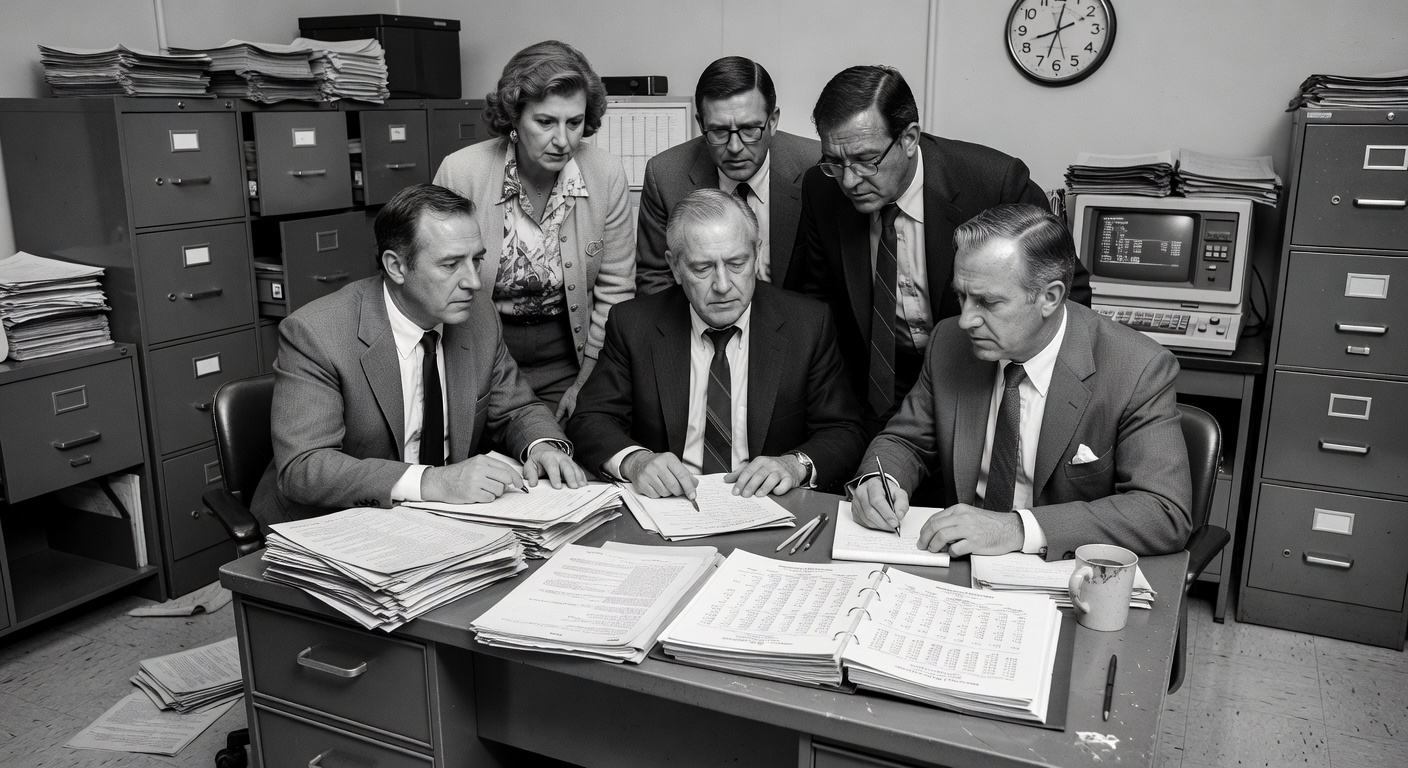
Generated by Grok Imagine (xAI), prompt: Generate a single 16:9 horizontal image for an educational lesson.
Lesson title: "The Inflation That Exists Because You Believe In It" · How expecting prices to rise can be enough to make them actuall…
Quiz yourself