Economics
·
Why Prices Rise
·
Monetary expansion
Medium
7 min
What Happens When You Print More Money
The one cause of inflation that Milton Friedman said explains all the others.
Share
Imagine everyone in the country wakes up tomorrow with twice as much money in their bank account. Sounds great, right? Now imagine what happens to prices by the end of the week.
Milton Friedman, in 1963, made one of the most sweeping claims in the history of economics: 'Inflation is always and everywhere a monetary phenomenon.' Not sometimes. Not mostly. Always. Everywhere.
That's a bold thing to say. And for decades, economists argued about it. But the more you understand how money actually works, the harder it is to disagree with him.
Here's the core idea: prices are just a ratio. The price of a coffee isn't really '$5.' It's '5 units of money per coffee.' Change the number of coffees, and the price changes — that's supply and demand, which you've already seen. But change the number of dollars floating around the economy, and every price changes. Not because goods got more or less scarce. Just because the measuring stick got longer.
Make your call
Back to the scenario from the start: everyone wakes up with twice as much money in their account. By the end of the week, what happens to prices? Take a guess before the answer.
A
Prices stay roughly the same — supply and demand haven't changed, so there's no reason for prices to move
B
Prices roughly double — twice as much money is now chasing the same amount of stuff
C
Prices rise a little, then settle back down as people save the extra money rather than spend it
Think about it this way. Say there's a tiny economy with exactly 10 apples and exactly $10 in circulation. Each apple costs $1. Simple.
Now the government prints $10 more and hands it out. There are still only 10 apples — nobody planted more trees, nothing changed on the supply side. But now there's $20 chasing those same 10 apples. The price per apple drifts toward $2. Not because apples got rarer. Because dollars got cheaper.
This is the quantity theory of money in its most naked form. More money, same stuff, higher prices. The math is almost embarrassingly straightforward. The real world is messier — but the core logic holds up across centuries of economic history.
So who actually controls the money supply? In most countries, it's the central bank — the Federal Reserve in the US, the European Central Bank in the eurozone, the Bank of England in the UK. They don't literally fire up a printing press (though sometimes they kind of do). Mostly they expand the money supply by buying financial assets — government bonds, mortgage-backed securities — and paying for them with newly created money. The banks that sell those assets suddenly have more cash, they lend more, and that new money ripples through the economy.
This is called quantitative easing, or QE. You've heard the term. It sounds technical and boring. It isn't. It's the mechanism by which central banks can, essentially, conjure purchasing power into existence.
For a long time, this seemed harmless. The Fed did massive rounds of QE after 2008, and inflation barely budged. Economists started wondering if Friedman was wrong. Then 2021 happened.
Example
During the COVID-19 pandemic, the US government sent out stimulus checks, boosted unemployment benefits, and handed out hundreds of billions in small business loans — all while the Federal Reserve bought over $4 trillion in assets to keep the financial system liquid. The M2 money supply — a broad measure of money in circulation — grew by about 27% in 2020 alone. That's the fastest expansion since World War II.
For a while, nothing seemed to happen. Prices were quiet. People said the old rules didn't apply anymore.
Then, starting in early 2021, inflation began climbing. By mid-2022, the US was seeing 9.1% annual inflation — the highest in 40 years. Groceries, rent, gas, used cars — everything. The money that had been injected into the system was now chasing goods and services that supply chains, still recovering from the pandemic, couldn't keep up with.
Was it purely monetary? No — there were supply shocks too, which you saw in the cost-push lesson. But the scale and persistence of that inflation? That was the money supply. That's the scenario from the hook playing out at national scale: everyone woke up with more money, and by the end of the year, prices told the whole story. Friedman, vindicated from the grave.
The relationship between money supply and inflation isn't instant. There's a lag — sometimes a long one. Friedman himself estimated it at 12 to 18 months on average. This is why it's so politically dangerous. A government can expand the money supply, enjoy a short-term boost in spending and employment, and then leave office before the inflation bill arrives. The next administration inherits the mess.
It also explains why central banks are supposed to be independent from governments. If politicians controlled the money printer directly, the temptation to juice the economy before every election would be overwhelming. Independent central banks exist specifically to resist that temptation. William McChesney Martin, the longest-serving Fed Chair in history, famously described the job as taking away the punch bowl before the party gets out of hand (1955).
Spoiler: they don't always succeed.
Key Insight
Inflation isn't just prices going up. It's the value of every dollar you hold going down. When the money supply expands faster than the economy grows, each unit of currency buys less. Your savings don't shrink on paper — but their real purchasing power quietly erodes. That's not an accident. That's arithmetic.
One more thing before we move on. You might be wondering: if printing money causes inflation, why do some countries print enormous amounts and barely see any price increases, while others print a little and spiral into chaos?
Two factors. First, how much the economy was already producing — if there's genuine economic slack (unemployed workers, idle factories), new money can fund real activity without just bidding up prices. Second, and this is the one that really matters: expectations. If people believe the central bank will keep inflation under control, they don't rush to spend money before it loses value. If they stop believing that, things can unravel fast.
That's the next mechanism — how inflation expectations become self-fulfilling. But you can already see how it connects: monetary expansion plants the seed. Expectations determine whether it grows into a manageable weed or a forest fire.
Sources
Images from Wikimedia Commons. Attribution required by license.
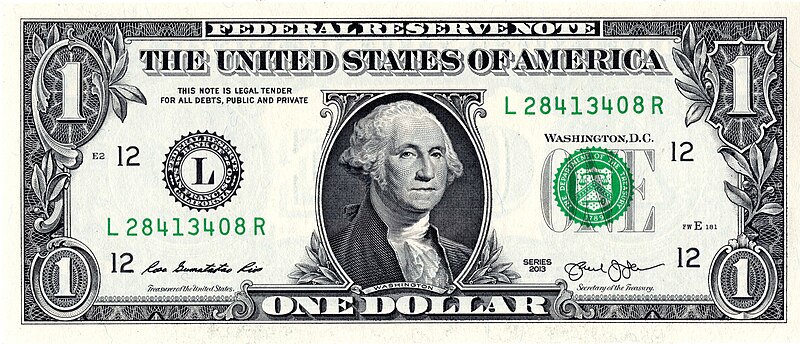
Obverse of the Series 2013 $1 Federal Reserve Note.
Bureau of Engraving and Printing · Public domain
The obverse of the 2009 Zimbabwe $100 trillion banknote.
Reserve Bank of Zimbabwe · Public domain
Milton Friedman economist portrait photograph
Generated by Grok Imagine (xAI), prompt: Generate a single 4:3 horizontal image for an educational lesson.
Lesson title: "What Happens When You Print More Money" · The one cause of inflation that Milton Friedman said explains all the others.…
Quiz yourself