Economics
·
Why Prices Rise
·
Cost-push
Medium
6 min
When Prices Rise and Nobody Spent More
Supply-side disruptions raise prices even when nobody is spending more.
Share
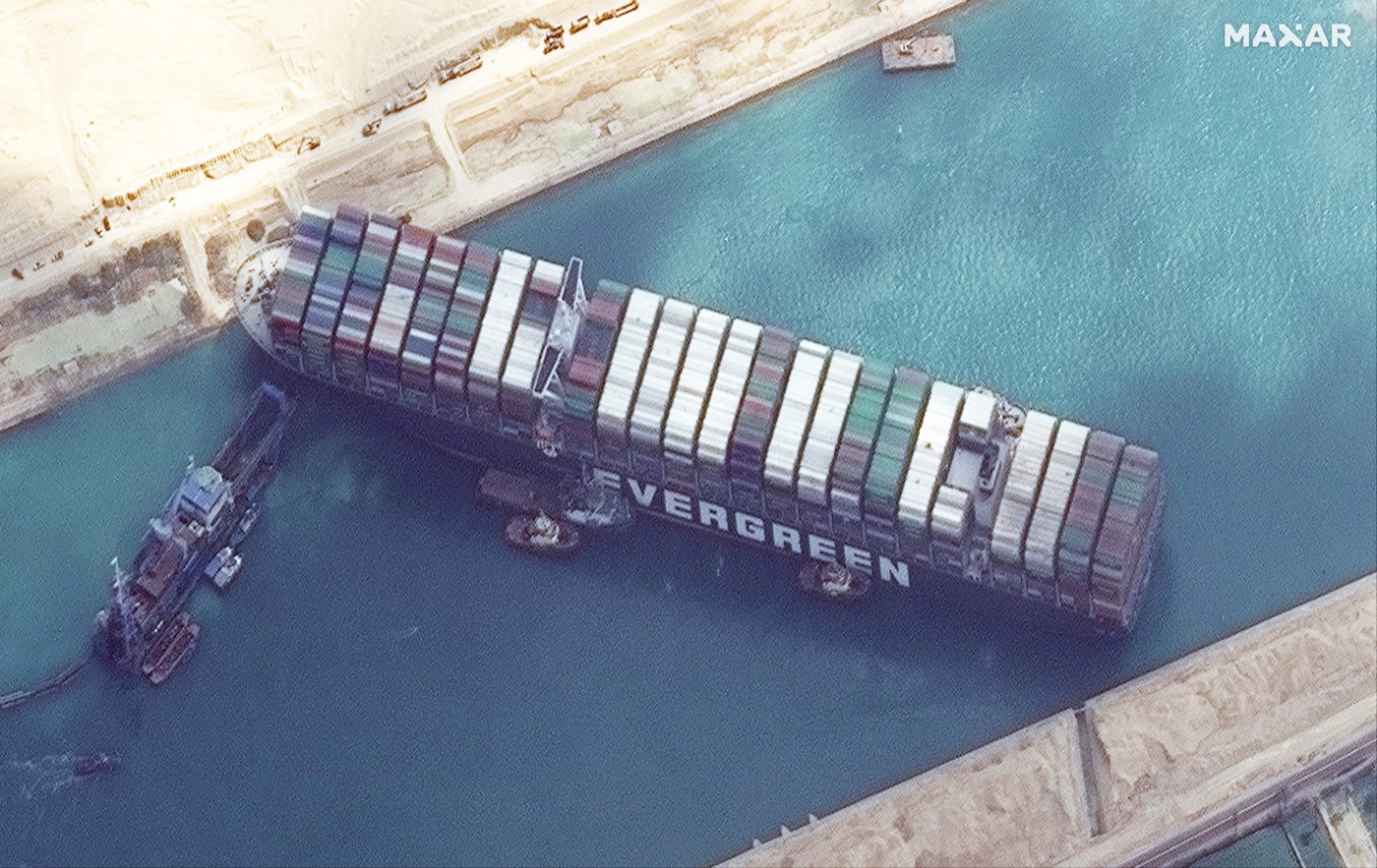
In 2021, a single container ship got stuck sideways in the Suez Canal for six days. Within weeks, the price of shipping a container from Asia to Europe had tripled. Factories sat idle. Store shelves thinned out. And none of it happened because consumers suddenly wanted more stuff.
Make your call
A massive cargo ship blocks a major canal for six days. What's the main reason store prices rise in the weeks that follow?
A
Consumers panic-buy, driving demand up and pulling prices higher
B
Shipping costs spike, raising the cost of getting goods to stores — so sellers charge more
C
The central bank prints money to cover the disruption, expanding the money supply
Demand-pull inflation is a spending problem — too much money chasing too few goods. Cost-push is the opposite. Prices rise because something in the production chain broke.
A war cuts off oil. A drought wipes out wheat. A virus shuts down factories. Suddenly the inputs that businesses need to make things — energy, raw materials, labor, transport — cost more. And businesses have two choices: eat the loss, or raise prices.
They raise prices.
Here's the mechanism in plain terms. Every product you buy is downstream of a hundred other products. Your morning coffee required electricity to roast the beans, diesel to ship them, aluminum for the can, and labor at every step. When the cost of any of those inputs jumps, the cost of producing coffee jumps with it — even if not a single extra person decided they wanted coffee today.
That's exactly what happened after the Suez blockage — and it's why cost-push inflation feels different from demand-pull. With demand-pull, the economy is booming and people are flush. With cost-push, the economy can be flat or shrinking — and prices are still rising. You're paying more and getting less. Economists call this stagflation. It's the worst of both worlds, and it's exactly what the 1970s served up.
Example
October 1973. OPEC — the cartel of oil-producing nations — announced an embargo against the United States for supporting Israel in the Yom Kippur War. Oil exports to the US stopped almost overnight.
The price of oil quadrupled in months. And because oil isn't just fuel — it's an input in plastics, fertilizers, chemicals, transport, heating — the price increase radiated outward through the entire economy. Farmers paid more to run tractors and buy fertilizer, so food got more expensive. Trucking companies paid more for diesel, so everything they moved got more expensive. Manufacturers paid more for energy, so every product they made got more expensive.
US inflation hit 12% by 1974. The Federal Reserve, confused and caught flat-footed, initially tried to stimulate the economy to fight the slowdown — which made the inflation worse. It took years and a brutal recession in the early 1980s to wring it out.
Example
Fast forward to 2021-2022. The mechanism ran again, this time from three directions at once.
First: COVID shutdowns had idled factories, especially in Asia. When demand snapped back faster than supply could recover, there weren't enough ships, containers, or port workers to move goods. Shipping costs from Shanghai to Los Angeles went from around $2,000 per container in early 2020 to over $20,000 by late 2021 — a 10x increase. That cost got passed on to everything inside those containers.
Second: Russia invaded Ukraine in February 2022. Ukraine and Russia together supply roughly 30% of the world's wheat and 15% of its corn. Wheat futures spiked 50% in the weeks after the invasion. Bread, pasta, cooking oil — all of it got more expensive globally, hitting lower-income countries especially hard.
Third: the same invasion disrupted European natural gas supplies. Energy costs for European manufacturers spiked so severely that some aluminum and fertilizer plants shut down entirely — they couldn't produce at a profit. Less supply, same demand, higher prices.
Three separate supply shocks, all hitting simultaneously. Inflation in the eurozone hit 10.6% in October 2022.
Key Insight
The brutal thing about cost-push inflation: raising interest rates — the central bank's main tool — doesn't fix it. Higher rates can cool demand, but they can't un-sink a ship or un-invade a country. When inflation is driven by a supply shock, monetary policy is fighting the wrong fire. You can slow the economy down, but the underlying cost problem stays until the supply problem is resolved.
So why does cost-push inflation ever end? A few ways.
Sometimes the supply shock resolves — the embargo lifts, the shipping backlog clears, the harvest recovers. Costs fall back toward normal and so do prices. Sometimes businesses adapt — they find alternative suppliers, redesign products to use less of the expensive input, or invest in technology that reduces dependence on it. The 1973 oil shock, painful as it was, triggered a wave of investment in fuel efficiency and alternative energy that slowly reduced how oil-dependent the economy was.
And sometimes it doesn't end cleanly. If workers see prices rising and demand higher wages to keep up, and businesses raise prices again to cover the higher wages — you get a wage-price spiral. That's a different mechanism — the wage-price spiral — and it starts exactly here.
Sources
Images from Wikimedia Commons. Attribution required by license.
A Claas Lexion 580 combine harvester fitted with a Claas V 900 header (9 m working width). Rear wheel hub repair. Ukraine, Vinnytsia rajon.
George Chernilevsky · CC BY 4.0
Quiz yourself