Civics
·
Who Actually Runs the World?
Medium
6 min
Who Actually Runs the World?
How countries follow rules without a world government to enforce them.
Share
There's no world police. No global president. No court that can throw a country in jail. So why do most countries follow international rules most of the time — and what happens when they don't?
Here's the core puzzle: every country is technically sovereign. That means no outside force can legally tell them what to do. And yet, right now, hundreds of countries are following rules they didn't write, paying dues to organizations they didn't create, and sending soldiers to wars they didn't start — all voluntarily. That's not an accident. That's international institutions doing exactly what they were designed to do.
Analogy
Think about your group chat when you're splitting a vacation rental. Nobody has legal authority over anyone else. But someone makes a spreadsheet, someone Venmos first to build trust, and slowly everyone chips in — not because they have to, but because the alternative is chaos and everyone loses the trip. International organizations are basically that spreadsheet, scaled up to 195 countries and nuclear weapons. The UN, NATO, WHO, WTO — they're coordination tools. They make it easier for countries to cooperate than to defect.
Take the United Nations, founded in 1945 after two world wars nearly destroyed civilization. The core idea was simple: give countries a place to talk before they start shooting. The UN has 193 member states. It passes resolutions, runs peacekeeping missions, and coordinates humanitarian aid. The UN has no army of its own and can't force any country to do anything. Its real power is legitimacy. Being condemned by the UN doesn't hurt physically. It hurts politically, diplomatically, economically. That's often enough.
Key Insight
The UN Security Council has five permanent members — the US, UK, France, Russia, and China — each with veto power. Any one of them can block any resolution. This sounds like a flaw. It's actually a feature. In 1945, the logic was: if the great powers can veto, they'll never be outvoted into a war they don't want. The cost is gridlock. The alternative was those five countries not joining at all.
NATO is a completely different animal. The UN is everyone talking. NATO is a specific group of countries promising to fight together. The core rule — Article 5 — says an attack on one member is an attack on all. That one sentence has kept the peace in Europe for 75 years, because attacking a NATO member means going to war with the entire alliance. It's a collective deterrent. It only works if everyone believes you'll actually follow through. And keeping that belief alive is a full-time diplomatic job.
Example
The World Trade Organization (WTO) shows what happens when economic cooperation gets complicated. Countries join because free trade makes everyone richer on paper. But then your steel industry collapses because cheaper imports wiped it out, and suddenly 'everyone benefits' feels abstract compared to the very concrete job losses in your district. The WTO has a dispute resolution system — basically an international trade court — where countries sue each other over tariffs and subsidies. The US has been both the biggest defender and the biggest violator of WTO rules, depending on who's in the White House. That tension is the whole story of international institutions in one example.
The WHO coordinates global health — disease surveillance, vaccine standards, emergency responses. You lived through its biggest test. In 2020, the WHO was simultaneously praised for sounding early alarms on COVID-19 and accused of being too slow, too deferential to China, and too underfunded to actually enforce anything. Both critiques were partly right. That's the structural problem with all international institutions: they're only as powerful as member countries allow them to be, and member countries tend to pull back exactly when the institution needs to act most.
Make your call
So here's the question the hook left open: why do most countries follow international rules most of the time — even though there's no world police to make them? What's actually keeping the system together?
A
Fear of military retaliation from powerful countries
B
Countries follow rules because breaking them costs them in every future interaction — trade, diplomacy, security
C
International law is legally binding and countries are obligated to comply
Key Insight
So back to the hook: no world police, no global president — why do countries follow the rules anyway? The real reason international institutions work isn't rules or enforcement. It's repeated games. Countries interact with each other constantly — trade, diplomacy, security, health. If you cheat today, you pay for it in every future interaction. International organizations make that cost visible and trackable. They don't replace trust. They create the conditions where trust can be built.
Sources
Images from Wikimedia Commons. Attribution required by license.
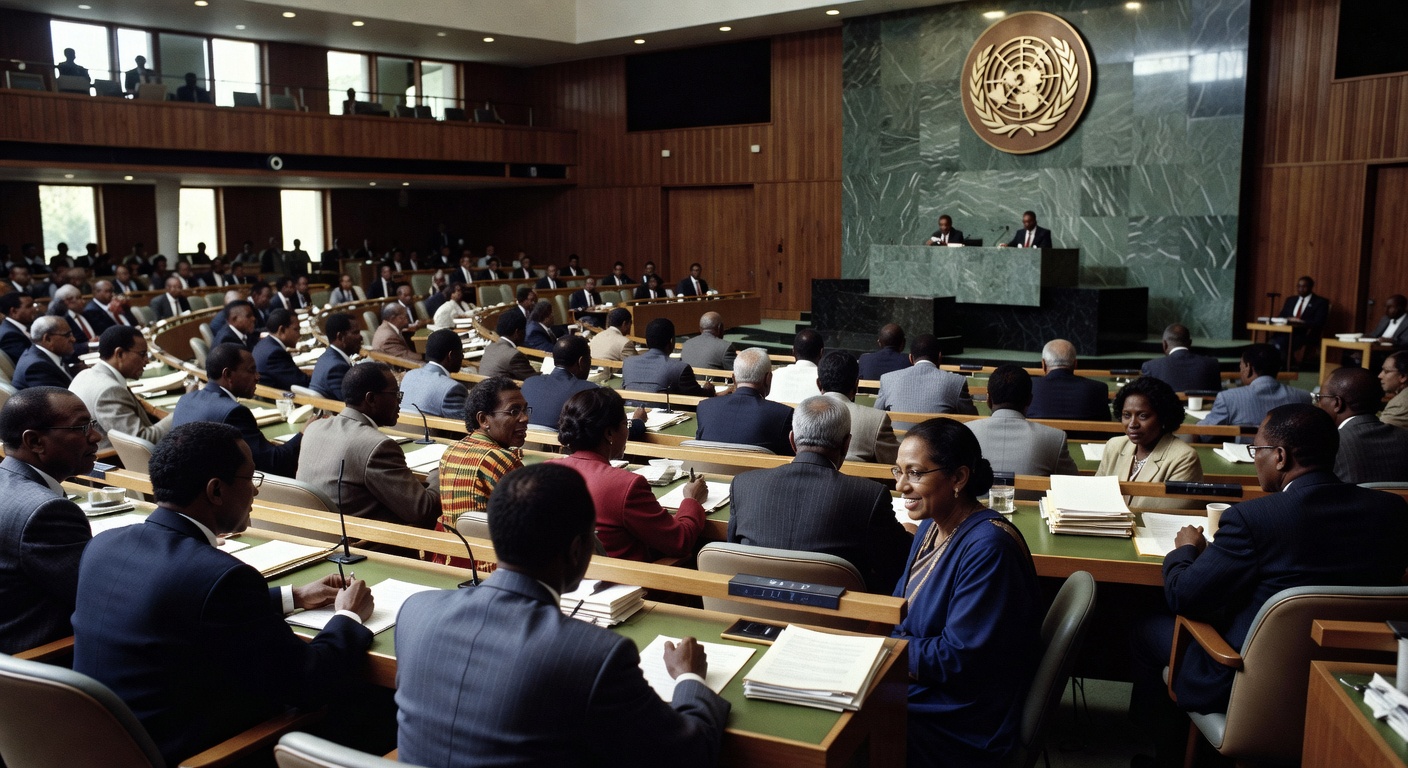
united nations assembly hall
Generated by Grok Imagine (xAI), prompt: Generate a single 16:9 horizontal image for an educational lesson.
Lesson title: "Who Actually Runs the World?" · How countries follow rules without a world government to enforce them.
Domain: civics
…
Secretary of State Antony J. Blinken participates in the UN Security Council meeting on Climate and Security at the United Nations in New York, New York, on September 23, 2021. [State Department photo by Ron Przysucha/ Public Domain]
U.S. Department of State from United States · Public domain
Quiz yourself