Civics
·
Where Does Your Tax Money Actually Go?
Medium
6 min
Where Does Your Tax Money Actually Go?
Most of the federal budget was already spoken for before anyone voted on anything.
Share
The U.S. government spends about $6 trillion a year. Congress loudly debates maybe 15% of it. The rest goes out the door automatically, every single year, no vote required.
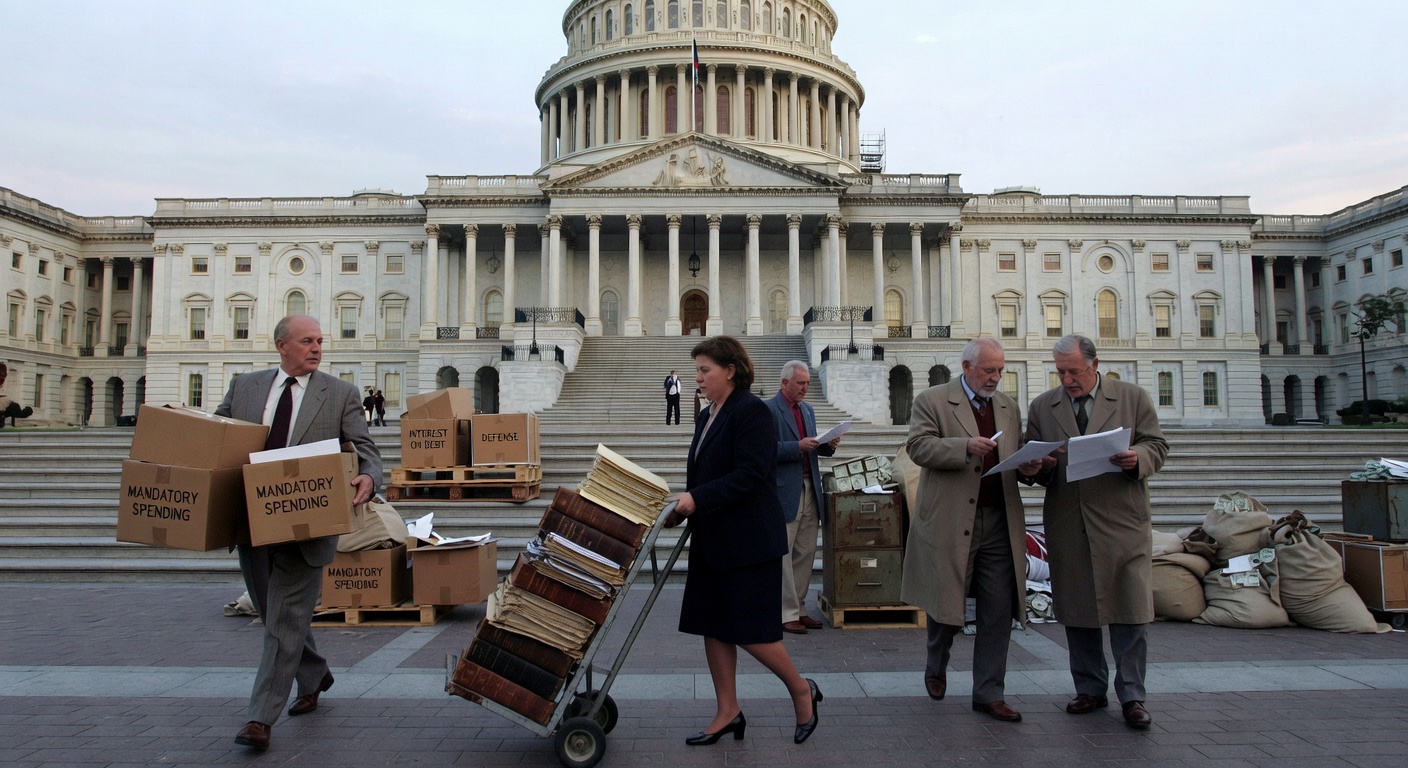
Most of the federal budget isn't really a budget at all. A real budget implies choices — you decide what gets funded, what gets cut, what's a priority. But roughly 70% of federal spending is what economists call 'mandatory spending.' That means Congress passed a law years ago that says: if you qualify, you get the money. No annual vote. No negotiation. It just happens. The actual discretionary fights you see on the news — government shutdowns, debt ceiling standoffs, arguments over defense vs. education — those are fights over the remaining slice. The big money is already locked in.
Analogy
Think about your own monthly finances. You've got rent, a phone bill, a streaming subscription, maybe a student loan payment. Those are locked in. They go out automatically. What's left — the money you actually decide how to spend each month on food, going out, clothes — that's your discretionary budget. Now imagine someone filmed you 'managing your money' and only showed you deciding between takeout and groceries. That's basically what C-SPAN covers. The big fixed costs? Already gone before the camera turns on. The federal budget works exactly like this, just with more zeros.
So what's actually in that mandatory 70%? Three things dominate. Social Security — monthly payments to retirees and disabled Americans — eats up about 21% of the entire federal budget. Medicare and Medicaid — health coverage for seniors and lower-income people — take another 25% or so. And then there's interest on the national debt, which is now over $800 billion a year and growing. That last one is particularly brutal: it's money the government pays just for having borrowed money in the past. It buys nothing new. It funds no program. It just... leaves.
Make your call
The U.S. spends $6 trillion a year. Before you read further — where do you think the single largest chunk of that money actually goes?
A
The military and defense
B
Social Security payments to retirees and disabled Americans
C
Interest payments on the national debt
Picture a pie chart. The biggest slice — nearly half the pie — is Social Security plus Medicare and Medicaid combined. The next slice, smaller but still significant, is defense spending (about 13%). Then a chunk for interest on the debt. What's left — everything else: education, infrastructure, scientific research, foreign aid, the FBI, NASA, the CDC — all of that fits into a slice that's maybe 15% of the pie. Every political fight you've ever heard about funding schools or cutting foreign aid? That's a fight over crumbs at the edge of that last slice.
Key Insight
The single largest line item in the U.S. federal budget isn't the military. It's Social Security. And it's not close. This surprises almost everyone — because the defense budget gets all the attention. But Social Security alone costs more than the entire Pentagon. This matters because if you want to seriously cut federal spending, you almost have to touch entitlements. Which is why almost no politician ever does.
Example
In 2023, the U.S. spent more on interest payments on the national debt than it spent on the entire defense budget. Let that land. More money went to paying off past borrowing than to the Army, Navy, Air Force, Marines, and nuclear arsenal combined. And because the debt keeps growing and interest rates rose sharply in 2022-2023, this number is on track to keep climbing. It's the fastest-growing part of the federal budget — and it produces nothing. No roads, no soldiers, no research. It's the financial equivalent of paying the minimum on a credit card and watching the balance go up anyway.
The discretionary budget — that 15% Congress actually votes on — gets split roughly in half between defense and everything else. 'Everything else' is called non-defense discretionary spending, and it includes: federal education funding, the NIH, NASA, the EPA, Amtrak, housing assistance, the State Department, foreign aid, federal courts, and hundreds of other programs. All of it combined is about the same size as the defense budget. That's the real answer to why Congress loudly debates 15% of the budget while the rest goes out the door automatically: the other 85% is either politically untouchable or legally locked in. So when you hear a politician promise to 'cut wasteful government spending,' ask them which half they mean — because cutting the entire non-defense discretionary budget to zero still wouldn't close the deficit. The math only works if you touch the big three: Social Security, Medicare, and defense. And those are the three things nobody wants to touch.
Sources
Images from Wikimedia Commons. Attribution required by license.
US Capitol building money
Generated by Grok Imagine (xAI), prompt: Generate a single 16:9 horizontal image for an educational lesson.
Lesson title: "Where Does Your Tax Money Actually Go?" · Most of the federal budget was already spoken for before anyone voted on any…
Federal Revenue and Spending
Wikideas1 · CC0
Quiz yourself