Civics
·
Where Does the Government Get All That Money?
Medium
7 min
Where Does the Government Get All That Money?
Every road, school, and military jet was paid for by taxes someone else decided you owed.
Share
The US federal government spent about $6.5 trillion last year. That's not borrowed money, not oil revenue, not lottery tickets. Almost all of it came from ordinary people going to work, buying things, and owning homes. The system that makes that happen is older, weirder, and more contested than you think.
Here's the core problem every government faces: it needs to pay for things — armies, roads, courts, hospitals — but it can't make money the way a business does. It doesn't sell a product. So it does something no business can legally do: it compels people to contribute. That compulsion has a name. Taxation. And the question of who pays, how much, and on what has been one of the most fought-over questions in all of human history. Wars have started over it. Revolutions too. The American one literally began with 'no taxation without representation.' So yeah — this matters.
The biggest source of government money in the US is the income tax. The idea is straightforward: you earn money, the government takes a percentage. It's not a flat percentage, though. It's a progressive system, which means the more you earn, the higher the rate you pay on each additional dollar. You earn $15,000? You're paying 10% on most of it. You earn $600,000? You're paying 37% on the top portion. Not on all of it — just on the slice above a certain threshold. This is called a marginal tax rate, and it trips people up constantly.
Make your call
Your friend just got a raise that pushes her into the next tax bracket. She's worried she'll actually take home less money than before. Is she right?
A
Yes — once you cross into a higher bracket, the new rate applies to everything you earn
B
No — only the dollars above the bracket threshold get taxed at the higher rate, so she always nets more
C
It depends on how far over the threshold she is — small raises near the line can cost you
Analogy
Think of it like a streaming subscription tier system, but in reverse. With Netflix, once you hit the premium tier, everything you watch is covered at that rate. With income taxes, each 'tier' of income gets taxed at its own rate — and moving into a higher bracket only affects the dollars above the line, not the ones below it. So if someone tells you 'I don't want a raise because it'll put me in a higher tax bracket,' they've misunderstood how this works. The raise always nets you more money. You never take home less by earning more. That myth refuses to die.
But the federal income tax is only one piece. There are two other major types you interact with constantly. Sales tax hits you every time you buy something — it's a percentage added at the register, and it varies wildly by state. Some states have none (Oregon, Montana). Others go above 9% when you stack state and local rates. Then there's property tax, which you pay if you own real estate — typically a percentage of your home's assessed value, collected by local governments. This is what funds most public schools in America. Which means where you grow up has a huge effect on your school's resources, since rich neighborhoods have higher property values and therefore more tax revenue. That's not an accident. It's a design choice — and a deeply controversial one.
Key Insight
Taxes aren't just about raising money. They're about shaping behavior and distributing costs. Every tax is a policy statement about who should pay for society — and who gets a break.
Example
Imagine you make $50,000 a year working a full-time job. Before you see a dollar of it, your employer withholds federal income tax, state income tax (if your state has one), and payroll taxes — which fund Social Security and Medicare. By the time your paycheck lands, you might be taking home 70-75 cents of every dollar you earned. Then you go buy groceries or a new laptop and pay sales tax on top of that. If you rent an apartment, your landlord pays property tax on the building — and you'd better believe that cost is baked into your rent. You are, in a very real sense, paying multiple taxes simultaneously, just not always in ways you can see.
Economists and politicians disagree sharply about what a 'fair' tax system looks like. Progressive taxation (higher rates on higher earners) is built on the logic that a dollar means more to someone who has fewer of them — so asking more from people who have more is proportionally less painful. But critics argue high rates on top earners reduce the incentive to work, invest, and build businesses. Then there's the flat tax argument: everyone pays the same percentage, no exceptions. Sounds equal — but if you earn $25,000 and pay 15%, that's a much bigger real-world sacrifice than if you earn $2.5 million and pay 15%. 'Equal' and 'fair' turn out to be different things. That tension is at the heart of almost every tax debate you'll ever hear — and it's why the system that funds $6.5 trillion a year remains, as promised, older, weirder, and more contested than most people expect.
Sources
Images from Wikimedia Commons. Attribution required by license.
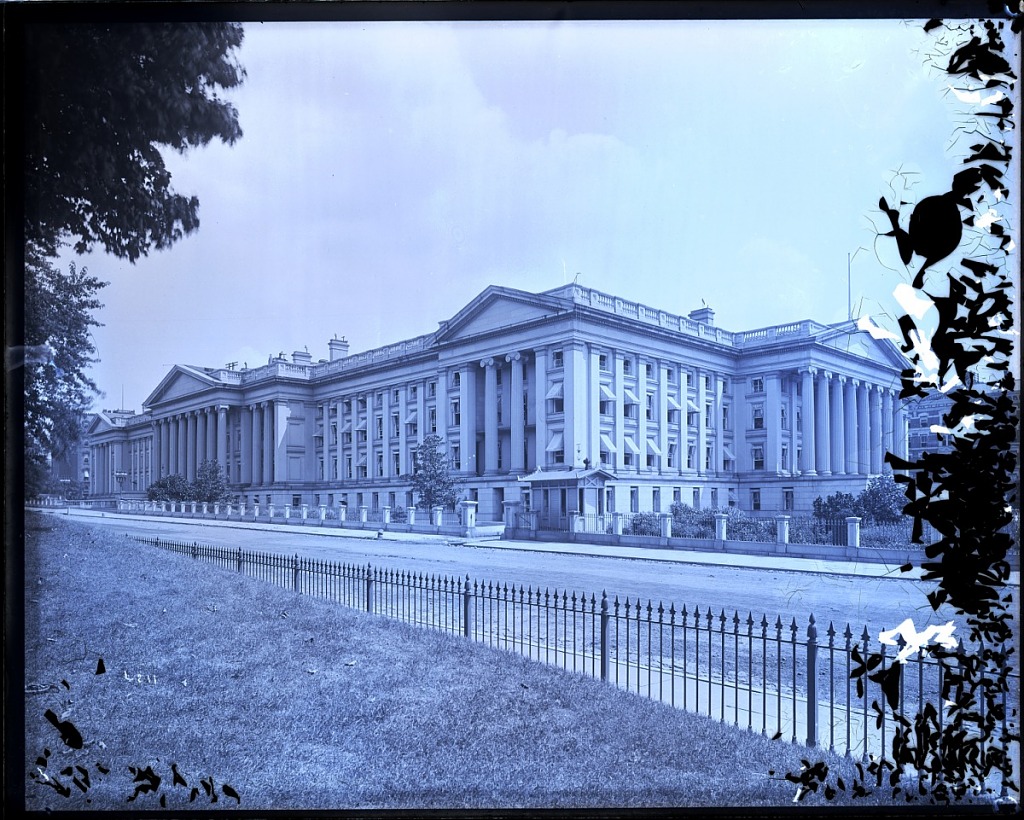
Exterior View of United States Treasury Building, Washington, D.C. — 1880
SIA via Smithsonian Open Access (CC0)
Title: Little fellow pays most of the taxes. Washington, D.C., Nov. 8. The House Ways and Means Sub-Committee learned today that taxpayers in the income bracket from $5,000 to $25,000 a year make most of the Capital gains and pay most of the tax, treasury experts who gave the information also presented a table showing that the Capital gains tax yielded $516,000,000 in 1929 and brought in approximately $85,000,000 last year, photographed at the hearing today were left to right: Cong. Robert Doughton, Chairman of the House Ways and Means Committee; Roswell Magill, Undersecretary of the Treasury; and Cong. Fred Vinson, Chairman of the House Sub-Committee. 11/8/37
Abstract/medium: 1 negative : glass ; 4 x 5 in. or smaller
Harris & Ewing, photographer · Public domain
Quiz yourself