Civics
·
Nine People Can Overrule Everyone
Medium
7 min
Nine People Can Overrule Everyone
How unelected judges became the most powerful check on government in American history
Share
Congress passes a law. The President signs it. Millions of people voted for the politicians who made it happen. Then nine unelected lawyers in robes say 'no' — and the whole thing dies. How is that even legal? And why did the Founders think it was a good idea?
The Constitution never actually says courts can strike down laws. The power that defines American democracy — the power that has shaped abortion rights, school segregation, free speech, and presidential elections — was essentially invented by a judge in 1803. His name was John Marshall, and what he pulled off was one of the most audacious legal moves in history.
Make your call
Congress passes a law, the President signs it, and millions of voters backed it. Can nine unelected judges really kill it — and where does that power come from? Where does judicial review actually appear in the Constitution?
A
It's spelled out in Article III, which establishes the judicial branch
B
It was added by the Bill of Rights to protect individual liberties
C
It isn't in the Constitution — a judge invented it in 1803
Example
The year is 1803. The political situation is a mess. Outgoing President John Adams, trying to pack the courts with his allies before leaving office, appointed a bunch of judges at the last minute. Incoming President Thomas Jefferson told his Secretary of State — James Madison — to just ignore the appointments and not deliver the official paperwork. One of those ignored judges, William Marbury, sued. The case landed at the Supreme Court. Chief Justice John Marshall faced a trap: rule in Marbury's favor and Jefferson would probably just ignore the Court (embarrassing). Rule against Marbury and Jefferson wins (also bad). Marshall found a third option nobody saw coming. He ruled that the law Marbury was using to sue was itself unconstitutional. Marshall surrendered the small fight to win the bigger one — he gave Jefferson the win on Marbury's commission and took the entire architecture of constitutional review in return. That's judicial review. And it stuck.
Key Insight
Judicial review is the power of courts to examine laws and government actions, and strike them down if they violate the Constitution — which answers the hook's question of how this is even legal: it's legal because the Court said so, and everyone agreed. It's not in the Constitution. It was claimed by the Supreme Court itself. And for 220+ years, every branch of government has accepted it.
So why doesn't this feel like a massive power grab? Two reasons. First, the Court can only rule on cases that come to it — it can't just scan laws it doesn't like and delete them. Someone has to be harmed, file a lawsuit, and fight it all the way to the top. That process takes years. Second, the Court has no army. No budget. No enforcement mechanism. When the Supreme Court ruled in 1954 that school segregation was unconstitutional in Brown v. Board of Education, President Eisenhower still had to send the National Guard to actually integrate schools. The Court's power is almost entirely moral authority — which sounds weak until you realize that moral authority, when people believe in it, is nearly unbreakable.
But pay attention. Because justices are appointed for life, they're deliberately insulated from political pressure. A senator who votes wrong gets voted out. A president who makes unpopular decisions loses reelection. A Supreme Court justice? They serve until they resign or die. Ruth Bader Ginsburg (1933–2020, Brooklyn, NY) — Associate Justice famous for her dissents and longevity on the Court — served until she was 87. That's the point — they're supposed to be immune to the crowd. The case for insulation: short-term democratic pressure has historically produced some of the worst constitutional outcomes — the internment of Japanese Americans, for instance, was popular. The case against: a court of nine people, appointed for life, can reshape society for decades with no accountability at all. That tension doesn't resolve. It's built into the system on purpose.
Key Insight
The Supreme Court's power ultimately rests on one thing: legitimacy. Every president, every Congress, every law enforcement agency has chosen to respect its rulings. That choice is never guaranteed. When President Andrew Jackson disagreed with a Court ruling about Native American land, he reportedly dismissed the ruling entirely — suggesting, in words whose exact phrasing historians still debate, that the Court had no way to make him comply. The system only works because most people, most of the time, agree to play by its rules.
Sources
Images from Wikimedia Commons. Attribution required by license.
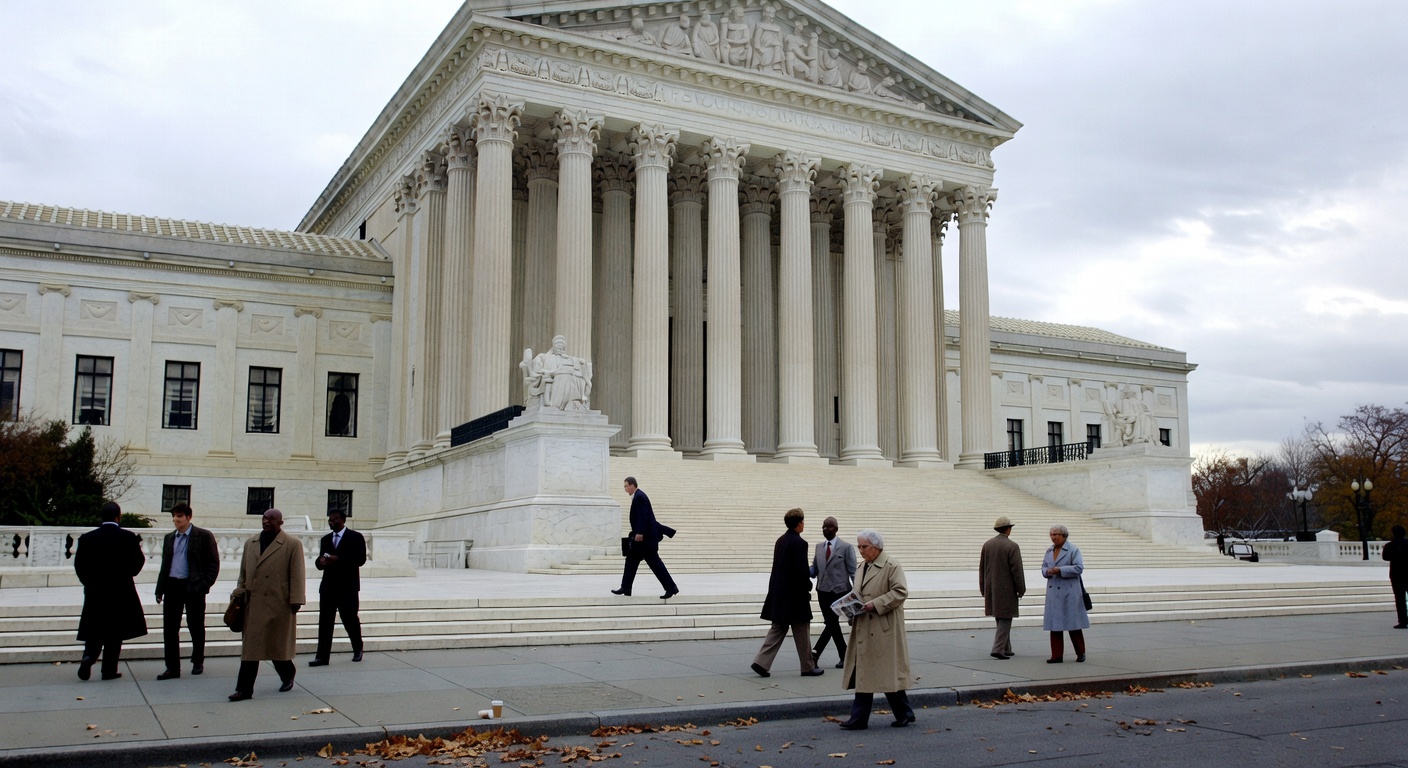
Supreme Court building
Generated by Grok Imagine (xAI), prompt: Generate a single 16:9 horizontal image for an educational lesson.
Lesson title: "Nine People Can Overrule Everyone" · How unelected judges became the most powerful check on government in American his…
[Chief Justice John Marshall, half-length portrait]
Library of Congress · Public Domain via Library of Congress
Quiz yourself