Civics
·
Political Parties Are Stranger Than You Think
Medium
7 min
Political Parties Are Stranger Than You Think
They are unstable coalitions held together by mutual self-interest and a shared enemy.
Share
If a socialist senator and a moderate suburban mom both call themselves Democrats, what exactly does that word mean? And why do two parties dominate a country of 330 million people with wildly different views?
A political party isn't an ideology. It's a coalition. A temporary alliance of groups who disagree on a lot of things but agree on one thing: they'd rather work together than let the other side win.
The Democratic Party contains progressive activists who want to abolish student debt AND moderate business owners who just want stable trade policy. The Republican Party contains libertarians who hate government AND social conservatives who want government very involved in personal life. These people don't fully agree. They just share an enemy.
That tension is the whole story of what parties actually do.
Day to day, a party recruits and vets candidates. Parties don't just accept anyone who shows up — they identify people who can win, help fund their campaigns, and pressure out candidates they think will lose badly or embarrass the brand.
The party also writes a platform — a document that says what it officially believes. Almost nobody reads it, and politicians aren't legally bound by it. It's less a contract and more a negotiated peace treaty between the party's factions.
The real power? Once politicians are elected, the party decides who gets which committee assignments, who leads which legislation, and who gets punished for breaking ranks. Fundraising access, committee chairmanships, the ability to actually pass bills — all of it flows through party leadership. That's where the leverage is, and it has nothing to do with the platform.
Key Insight
The platform is a peace treaty, not a promise. It tells you what each faction of the party had to give up to stay in the coalition — not necessarily what any individual politician will actually fight for.
Make your call
So why do a socialist senator and a moderate suburban mom both call themselves Democrats — and why does that coalition hold? What actually keeps the two-party system from splitting apart?
A
Voters and politicians genuinely share enough core values to stay united
B
The winner-take-all voting system makes splitting a guaranteed way to lose
C
Party rules and the platform legally bind members to cooperate
The US has had dozens of parties throughout history. Third parties run candidates constantly. And yet, for over 150 years, the same two parties have dominated everything.
The answer is the rules. America uses a 'winner-take-all' voting system, which political scientists call first-past-the-post. In every race, one person wins and everyone else gets nothing. No partial credit for coming in second.
This creates a brutal math problem for third parties. If you vote for a candidate you love who has no realistic shot of winning, you've effectively handed your vote to whoever you hate most. Voters figure this out fast. So they hold their nose and vote for whoever they hate less — which keeps the two major parties alive even when everyone's frustrated with both of them.
Example
The 2000 presidential election is the clearest example of this trap in action. Ralph Nader ran as a Green Party candidate and got about 97,000 votes in Florida. George W. Bush beat Al Gore in Florida by 537 votes. If even a small fraction of Nader's voters had chosen Gore as their second choice — which polls suggested they would have — Gore wins Florida, wins the presidency.
Nader voters didn't intend to elect Bush. But the math of winner-take-all turned their sincere vote into an effective vote for their least-preferred outcome. This is why third-party candidates get called 'spoilers' — and why the two-party system is so hard to break.
That trapped feeling is exactly what both parties are counting on. Because voters can't easily leave, neither party faces much pressure to actually satisfy its base. So they spend enormous energy not on inspiring their own voters, but on making the other party look terrifying enough that their coalition holds together despite its internal contradictions.
Fear of the other side is the glue — which is why political advertising is almost entirely negative.
Key Insight
That's the answer to why a socialist senator and a moderate suburban mom share a party label: the two-party system isn't held together by shared belief. It's held together by a voting system that punishes you for leaving. Once you see that, a lot of political behavior that seems irrational suddenly makes perfect sense.
Sources
Images from Wikimedia Commons. Attribution required by license.
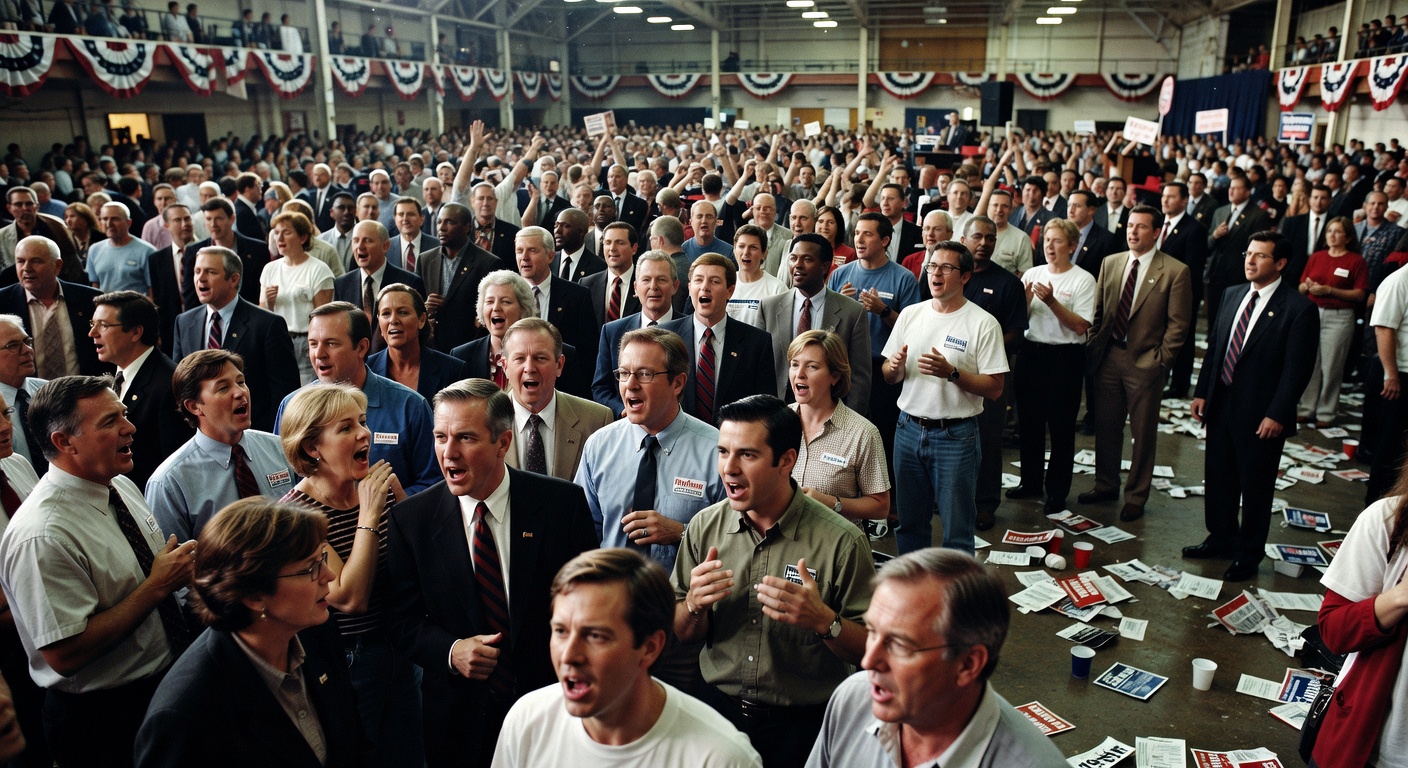
political convention crowd
Generated by Grok Imagine (xAI), prompt: Generate a single 16:9 horizontal image for an educational lesson.
Lesson title: "Political Parties Are Stranger Than You Think" · They are unstable coalitions held together by mutual self-interest an…
[Republican schoolhouse, Rippon, Wisconsin. Scene of the meeting, Mar. 20, 1854, at which Wisc. people claim the Republican Party was founded]
Library of Congress · Public Domain via Library of Congress
Quiz yourself