Civics
·
Why Do You Actually Follow the Rules?
Easy
5 min
Why Do You Actually Follow the Rules?
The invisible agreement that makes civilization possible
Share
You've never signed a contract with your government. No one asked for your consent. You didn't agree to pay taxes, follow traffic laws, or accept a court's verdict. So why do you? And more unsettling — why does almost everyone else?
Imagine there's no government. No police, no courts, no army. Just people. What happens?
At first, maybe nothing. You have your stuff, your neighbors have theirs. But then someone stronger than you decides they want your stuff. You can't call anyone. There's no law saying they can't take it. There's no judge to appeal to. The only thing stopping them is whether you can physically stop them yourself.
This is what philosopher Thomas Hobbes (1588–1679, England) called the 'state of nature' — life without any governing authority. His verdict was brutal: life would be 'solitary, poor, nasty, brutish, and short.' Every person for themselves, every day a potential fight for survival.
Make your call
You've never signed a contract with your government — so why do you follow its rules? What's the real reason almost everyone goes along with a system they never agreed to?
A
Because the government has the power to punish you if you don't
B
Because living in society means you're already part of an exchange — protection and order in return for some freedom
C
Because most laws are reasonable, and reasonable people naturally follow reasonable rules
Humans figured out, independently, across thousands of years and cultures: you give up some freedom in exchange for security and order.
You agree not to steal from your neighbors. In return, they agree not to steal from you — and there's a system to punish anyone who breaks the deal. You pay taxes. In return, you get roads, fire departments, and courts. You follow laws you didn't personally write. In return, those same laws protect you.
This is the social contract. Not a literal document. A conceptual agreement — the idea that government's authority comes from the consent of the people it governs, and in exchange, it has to actually serve their interests.
Key Insight
The social contract only works if both sides hold up their end. You give up some freedom. The government delivers security and order. The moment it stops — stops protecting people, starts only serving the powerful — the contract breaks. That's the philosophical justification for revolution.
Three thinkers shaped how we understand this deal today, and they disagreed sharply on the details.
Hobbes thought humans were naturally selfish and chaotic — so we need a powerful government to keep everyone in line, even if that means giving up a lot of freedom. He'd seen England tear itself apart in civil war and wasn't romantic about human nature. A strong hand beats a free-for-all.
John Locke (1632–1704, England) thought humans were basically reasonable and had natural rights — life, liberty, and property — that existed before any government. Government's only job is to protect those rights. If it violates them, people have the right to replace it. Sound familiar? Jefferson leaned heavily on Locke when he drafted the Declaration of Independence — 'life, liberty, and the pursuit of happiness' is a deliberate riff on Locke's 'life, liberty, and property.'
Jean-Jacques Rousseau (1712–1778, Geneva) thought the real problem was inequality — that society itself corrupts naturally good people. Government should express the 'general will' of the people, not just protect the powerful few who already have property. The arguments between these three are still playing out in every election you'll ever vote in.
Example
This stops being abstract fast. In 2020, when COVID hit, governments worldwide made a very explicit version of the social contract visible: restrict your movement, close your business, wear a mask — in exchange for slowing a virus that could kill your neighbors and overwhelm hospitals.
Some people accepted that trade-off. Others didn't — they felt the government was taking too much freedom without delivering enough security in return. That exact tension — how much freedom do you give up, and what do you get back — is the social contract debate happening in real time.
Every major political fight is really a fight about where to draw that line.
Key Insight
Remember the opening question — why do you follow rules you never agreed to? You didn't choose to be born into your country. You didn't sign anything. But by living here, using the roads, calling the police when you need them, and relying on the courts — you're already on the receiving end of the deal. That's not a trap. That's just what civilization is. The question worth asking isn't whether to participate, but whether the terms are fair.
Sources
Images from Wikimedia Commons. Attribution required by license.
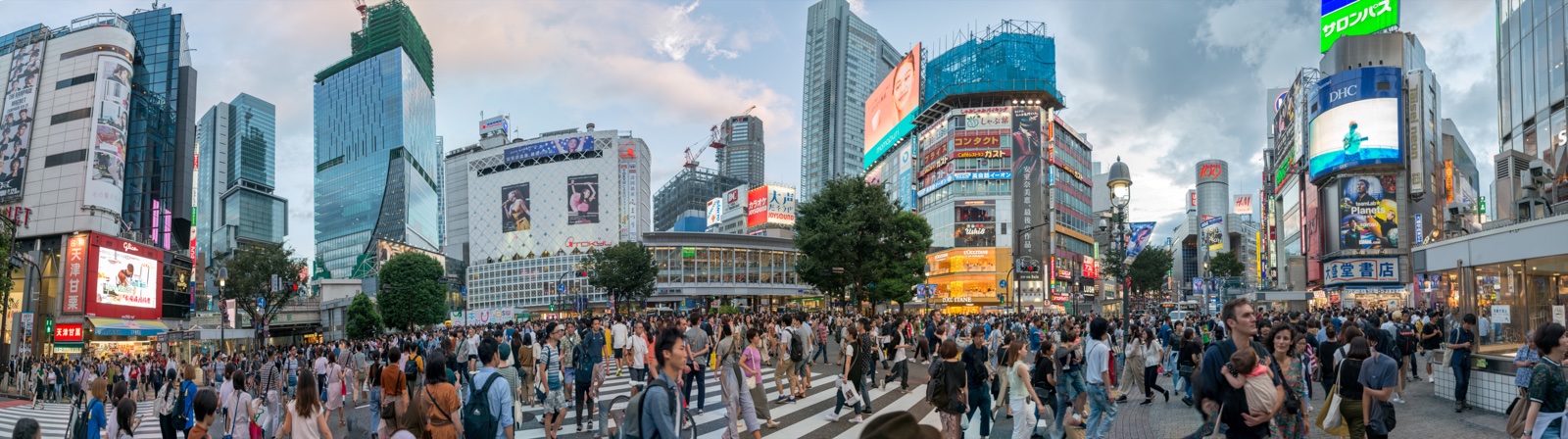
Shibuya is famous for its scramble crossing. It is located in front of the Shibuya Station Hachikō exit and stops vehicles in all directions to allow pedestrians to inundate the entire intersection. The statue of Hachikō, a dog, between the station and the intersection, is a common meeting place and almost always crowded.
Three large TV screens mounted on nearby buildings overlook the crossing, as well as many advertising signs. The Starbucks store overlooking the crossing is also one of the busiest in the world. Its heavy traffic and inundation of advertising have led to it being compared to the Times Square intersection in New York City and Dundas Square intersection in Toronto. Tokyo-based architecture professor Julian Worrall has said Shibuya Crossing is "a great example of what Tokyo does best when it's not trying."
Shibuya Crossing is often featured in movies and television shows which take place in Tokyo, such as Lost in Translation, The Fast and the Furious: Tokyo Drift, and Resident Evil: Afterlife and Retribution, as well as on domestic and international news broadcasts. The iconic video screen featured in the above movies, in particular Lost in Translation with its 'walking dinosaur' scene, was taken down for a period of time and replaced with static advertising, although it resumed operation in July 2013. Contemporary British painter Carl Randall (who spent 10 years living in Tokyo as an artist) depicted the area in his large artwork 'Shibuya', exhibited at the National Portrait Gallery in London 2013.
On the southwest side of Shibuya station, there is another popular meeting place with a statue called "Moyai". The statue resembles a Moai statue, and it was given to Shibuya by the people of Niijima Island in 1980.
The crossing was featured in the 2016 Summer Olympics closing ceremony to promote the 2020 Summer Olympics in Tokyo [Wikipedia.org]
Jorge Láscar from Melbourne, Australia · CC BY 2.0
Ink drawing on manuscript offered by Thomas Hobbes to Charles II.
Wenceslas Hollar or (more likely) Abraham Bosse. · Public domain
Quiz yourself